
Recruitment Operations
12 min readFrom Volume Sourcing to Precision AI Matching: Elevating Retention and Interview Quality
Discover why modern recruiting firms are shifting from noisy resume volume to precision AI matching. Learn how specialized staffing agency software solutions cut time to hire, improve interview quality, and drive long-term retention across tech, healthcare, dental, and event staffing.
By Dana Ostrowski · VP of RevOps, Ellevva ·
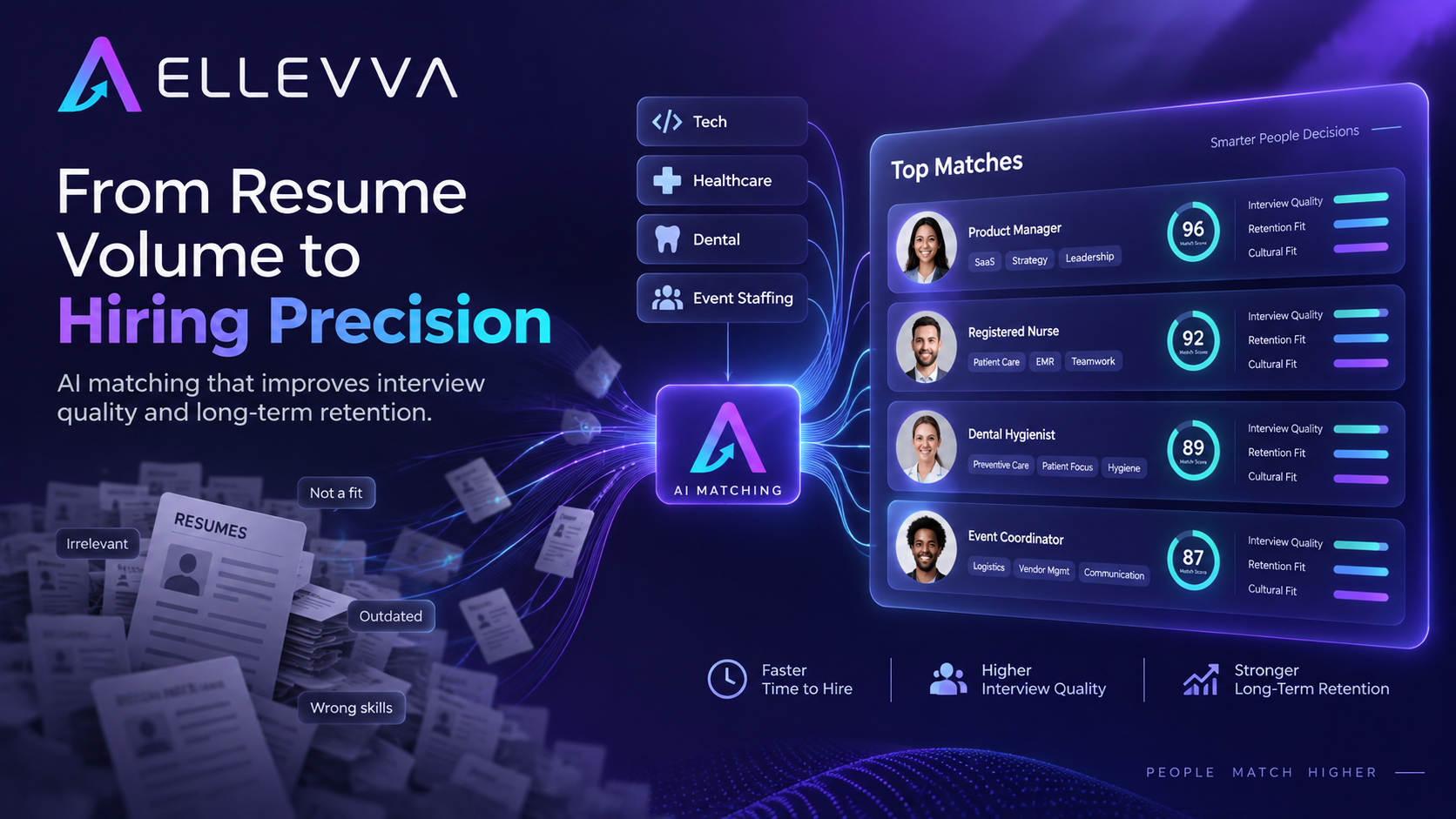
For over two decades, the staffing industry operated under a single dominant premise: recruiting is a numbers game. Agencies believed that if they blasted enough job boards, accumulated tens of thousands of resumes in an applicant tracking system (ATS), and pushed hundreds of semi-relevant profiles to client hiring managers, placements would naturally follow.
Today, that legacy playbook is broken.
The flood of one-click job applications, generative AI resume builders, and automated application bots has diluted candidate pools. Staffing agencies face unprecedented pipeline noise, recruiter burnout, and plummeting interview-to-placement ratios. When clients receive 20 resumes only to find that two are qualified and neither fits the cultural or operational context, trust erodes. Even worse, placements made under volume-based pressure often suffer from early turnover, damaging client retention and agency reputation.
To build a sustainable, high-margin agency, firms are shifting from brute-force volume sourcing to precision AI matching. By adopting purpose-built recruitment software for staffing agency operations, forward-thinking leaders are turning hiring into a high-signal science that enhances interview quality, reduces overhead, and guarantees higher candidate retention.

The True Cost of Volume-Based Applicant Sourcing
Volume-based sourcing creates an illusion of productivity. Dashboards display thousands of active candidates, yet placement velocity stalls. When you dissect the unit economics of traditional agency workflows, the hidden costs of volume become apparent:
- Recruiter Fatigue and Pipeline Drag: Recruiters spend up to 70% of their working hours sifting through unqualified resumes, reading keyword-stuffed PDFs, and chasing unverified candidate profiles.
- Low Interview-to-Offer Conversion: When hiring managers interview poorly matched candidates, agency credibility plummets. A 5:1 or 8:1 interview-to-placement ratio drains internal client resources and lengthens hiring cycles.
- Post-Placement Churn: Candidates matched solely on surface-level keywords often lack the contextual experience, operational stamina, or workplace alignment needed for the role, leading to premature drop-offs within the first 90 days.
- Fragmented Tech Stacks: Running disconnected tools for sourcing, credentialing, timesheets, and invoicing creates operational silos where crucial candidate data gets lost.
To reverse these bottlenecks, modern agencies rely on integrated recruitment operations metrics that prioritize candidate engagement quality, interview velocity, and placement retention over raw applicant counts.
What Is Precision AI Matching?
Precision AI matching goes beyond traditional Boolean keyword search. Keyword searches look for literal string matches—such as Kubernetes or ICU RN—which can easily be gamed by candidate resume optimization tools. In contrast, modern AI matching models evaluate multi-dimensional signals across the entire talent lifecycle:
- Semantic Competency Mapping: Understanding that a candidate who built distributed caching layers in Go possess adjacent skills applicable to high-throughput cloud infrastructure, even if a specific brand-name tool is missing from their CV.
- Contextual Career Trajectory: Evaluating the scale of past projects, team topologies, shift lengths, or industry environments rather than just years of experience.
- Availability and Intent Scoring: Analyzing responsiveness, historical placement records, credential verification, and verified working preferences.
- Cultural and Operational Compatibility: Aligning shift patterns, remote collaboration styles, and pacing requirements to ensure long-term retention.
By leveraging intelligent models that digest structured and unstructured data, AI matching improves hiring velocity by surfacing the top 3–5 high-probability candidates in seconds rather than requiring days of manual filtering.
How to Reduce the Time to Hire with AI Precision
One of the most pressing questions agency founders and talent acquisition executives ask is how to reduce the time to hire without sacrificing placement quality. In agency staffing, time kills deals: top candidates are off the market within 10 to 14 days, and client hiring demands often require immediate fulfillment.
Understanding the key factors that can reduce time to hire reveals why precision AI matching is so transformative:
| Hiring Stage | Legacy Volume Workflow | Precision AI Workflow | Impact on Velocity |
|---|---|---|---|
| Sourcing & Discovery | Manual job boards, static database queries (3–5 days) | Instant semantic database indexing & real-time pool discovery (< 2 hours) | 80% faster candidate identification |
| Screening & Shortlisting | Manual resume review, repetitive introductory calls (4–7 days) | Automated credential checks, scoring algorithms, verified profile review (Same day) | Cuts screening backlog by 75% |
| Candidate Submission | 10–15 unvetted resumes sent per role | 3 verified, highly matched profiles with structured scorecards | Improves interview conversion from 20% to over 60% |
| Scheduling & Coordination | Back-and-forth emails, double-booked calendar slots (3–4 days) | Automated calendar matching and self-serve interview booking | Eliminates administrative scheduling friction |
| Offer & Placement | Delayed background checks and manual onboarding | Continuous compliance workflows, automated documentation | Compresses total hiring cycle from 35+ days to under 14 days |
When recruitment teams minimize manual touches, recruiters shift their focus from administrative screening to relationship-building and closing top talent.
Vertical-Specific Implementations: Beyond Generic Staffing
Different industries demand distinct matching parameters. A single, generic database cannot handle the compliance demands of acute care nursing, the technical depth of cloud engineering, the rapid roster turnaround of hospitality events, or the localized licensing of dental practices. Modern staffing agency software solutions have evolved to provide deep, vertical-specific intelligence.
1. Technology and Software Engineering
In the technology sector, identifying top software talent requires understanding architectural depth, systems design capabilities, and distributed collaboration. A traditional agency might match a staffing agency software engineer candidate based simply on the word "Python." However, precision AI evaluates whether that engineer used Python for rapid prototyping, asynchronous data pipelines, or machine learning infrastructure.
Furthermore, as companies scale globally, sourcing global talent in software introduces challenges around timezone overlap, regional compensation benchmarks, and cross-border compliance. Sophisticated tech recruitment engines assess full-stack capabilities, code repository activity, and communication nuance across distributed talent hubs in North America, Europe, Latin America, and Asia.
2. Healthcare and Nursing Staffing
Healthcare recruitment is governed by rigorous regulatory standards, license authentications, and unpredictable patient census levels. Generic agency tools frequently fail when managing credential expiration, multi-state compact licenses, and hospital unit specialties.
Dedicated nurse staffing agency software and nursing staffing agency software integrate AI matching with automated verification checks (BLS, ACLS, state board licenses, immunization records). Coupled with healthcare staffing agency scheduling software, these platforms match per diem nurses or travel nurses based on unit competency, shift preference, commute distance, and institutional EHR familiarity (e.g., Epic or Cerner). Specialized SaaS staffing agency software, such as CarePro-style operational architectures, unifies patient-to-nurse ratio requirements with real-time roster matching, preventing compliance breaches and caregiver burnout.

3. Dental Practice Staffing
Dental clinics face urgent, short-notice vacancies when hygienists, dental assistants, or associate dentists become unavailable. High-performing dental staffing agency software leverages geo-location mapping, practice management software familiarity (e.g., Dentrix, Eaglesoft), and state radiology certifications to execute short-term fill-ins or permanent placements within hours, keeping operatories productive.
4. Event and Hospitality Staffing
Event management relies on rapid burst hiring. Whether staffing a 500-person corporate summit, music festival, or stadium hospitality suite, event staffing agency software must match candidates based on physical presence, uniform standards, certifications (such as TIPS or food safety handling), and punctuality ratings from prior engagements.
Evolution of the Staffing Agency Software Market
The broader staffing agency software market has transformed from isolated on-premise relational databases into unified, intelligent operating systems. Historically, agencies stitched together five to seven disparate point solutions:
- A standalone ATS for candidate parsing
- A separate CRM for client business development
- Third-party job board aggregators for volume sourcing
- Standalone shift scheduling modules
- Disconnected staffing agency billing software and payroll tools
- Manual spreadsheets for recruiter commission tracking
This fragmented setup led to data decay, lost placements, and painful reconciliation cycles at the end of every financial month.
Today, modern staffing agency software development prioritizes unified data models where applicant tracking, client relationship management, AI matching, credentialing, shift scheduling, and financial invoicing operate within one shared ecosystem. When an agency places a candidate, the system automatically triggers onboarding documentation, allocates timesheet schedules, and feeds verified hours directly into billing modules—eliminating double data entry and administrative overhead.
+-----------------------------------------------------------------------------------+
|                       UNIFIED AI STAFFING OPERATING SYSTEM                         |
+-----------------------------------------------------------------------------------+
|                                                                                   |
|   +---------------------+   +---------------------+   +---------------------+     |
|   |    AI Sourcing &    |   |   ATS & Pipeline    |   |   Credentialing &   |     |
|   |  Precision Match    |-->|     Management      |-->|     Compliance      |     |
|   +---------------------+   +---------------------+   +---------------------+     |
|              |                         |                         |                |
|              v                         v                         v                |
|   +---------------------+   +---------------------+   +---------------------+     |
|   |  Multi-Industry     |   | Dynamic Scheduling  |   | Automated Invoicing |     |
|   | Shift Coordination  |-->|  & Time Tracking    |-->|    & Gross Margin   |     |
|   +---------------------+   +---------------------+   +---------------------+     |
|                                                                                   |
+-----------------------------------------------------------------------------------+
Blueprint: Transitioning Your Agency from Volume to Precision AI
Transitioning an established agency away from volume sourcing requires deliberate workflow adjustments. Here is a step-by-step roadmap to implement precision AI matching without disrupting daily revenue generation:
Step 1: Clean and Enrich Your Existing Talent Database
Your internal database is your most valuable asset, but older candidate records quickly become obsolete. Use AI data enrichment to refresh contact details, update skills taxonomy, standardize job titles, and index candidate histories. Dormant profiles can be reactivated with targeted, automated check-ins before you spend capital on external job boards.
Step 2: Establish Multi-Signal Requirement Intake
Stop taking one-paragraph job descriptions from clients. Configure your requirement intake process to capture nuanced context:
- Must-have technical or clinical skills vs. trainable adjacent capabilities
- Team velocity and working cadences (e.g., async communication, specific tech stacks, high-volume patient units)
- Schedule constraints, shift rotations, or remote time-zone bands
- Core reasons prior employees succeeded or struggled in the role
Step 3: Implement Calibrated Scoring Thresholds
Configure matching algorithms so recruiters only review candidates scoring above an established compatibility threshold (e.g., 85%+ semantic fit). Instead of sending clients 15 resumes, institute a strict policy of submitting the top 3 verified matches, complete with an AI-generated scorecard summarizing why each profile fits the requirement.
Step 4: Measure Retention and Quality of Hire Metrics
Track placement performance beyond the initial invoice. Monitor 30-, 60-, and 90-day retention rates, client interview feedback scores, and contractor re-deployment percentages. Feeding this post-placement feedback back into your matching platform trains the system to make even sharper recommendations over time.
Why Precision AI Matching Drives Client and Candidate Loyalty
The benefits of precision AI matching extend to every stakeholder in the hiring ecosystem:
For Hiring Clients
- Higher Interview Quality: Hiring managers no longer waste valuable hours speaking with mismatched candidates.
- Lower Attrition Costs: Accurate technical, cultural, and operational alignment dramatically reduces 90-day employee turnover.
- Predictable SLA Delivery: Positions are filled reliably within targeted timeframes, protecting client revenue and project timelines.
For Candidates
- Relevant Opportunities: Candidates are approached only for roles that genuinely match their skills, career ambitions, and compensation expectations.
- Transparent Pipeline Updates: Automated workflows keep talent informed at every stage of the interview cycle, eliminating candidate ghosting.
- Faster Placements: Pre-screened, verified profiles move quickly through client review stages without redundant interview steps.
For Staffing Agencies
- Higher Gross Margins: Increased recruiter productivity means each recruiter can manage 3x to 5x more active requirements without burning out.
- Sticky Client Relationships: Clients treat precision-first agencies as strategic advisors rather than interchangeable resume brokers.
- Scalable Operations: Cloud-native platforms allow agencies to expand across geographies and sectors without adding linear administrative headcount.
The Future of Agency Sourcing: Precision as a Competitive Moat
The staffing industry is reaching a clear inflection point. Agencies that cling to legacy volume sourcing will find themselves trapped in a race to the bottom—competing on thin margins, battling candidate noise, and struggling with client churn.
Conversely, agencies that adopt precision AI matching transform their entire operational model. By pairing intelligent semantic matching, automated credentialing, and unified back-office workflows, these agencies deliver superior placement accuracy, faster turnaround times, and outstanding retention rates across tech, healthcare, dental, and event industries.
Ready to elevate your agency's hiring outcomes? [Explore Ellevva's AI recruitment solutions](https://www.ellevva.com/solutions) and see how modern intelligent matching helps your team shortlist top talent, streamline operations, and scale placement volume with confidence.