
Recruitment Operations
10 min readThe Modern Staffing Agency Tech Stack: Software, Systems, and Strategies to Slash Time to Hire
Discover how modern staffing agency software—from AI matching, scheduling, and payroll to specialized industry workflows and hiring analytics—dramatically accelerates recruitment cycles and reduces time to hire.
By Dana Ostrowski · VP of RevOps, Ellevva ·
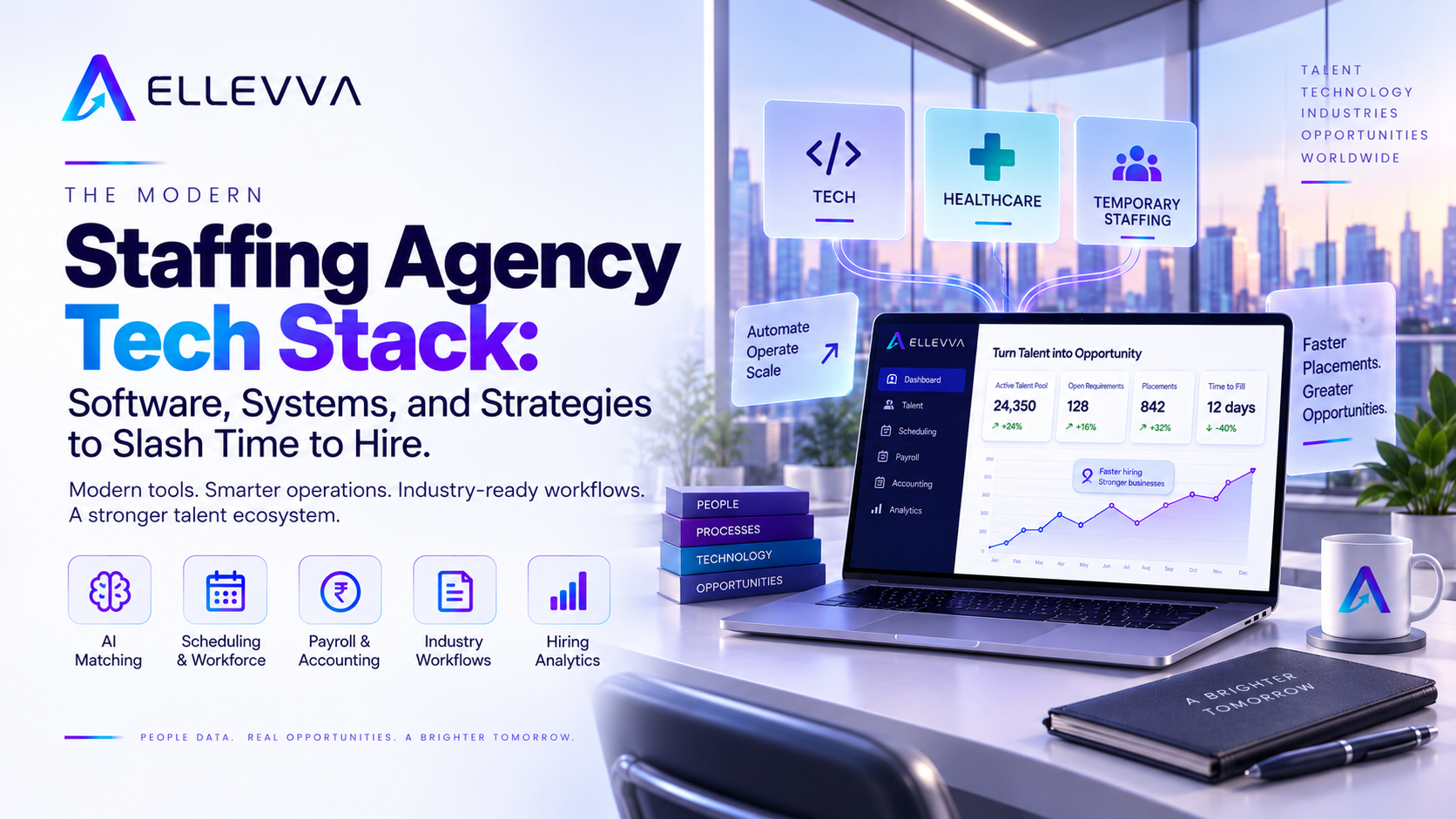
Recruitment agencies and staffing firms operate in an unforgiving commercial landscape. Client expectations have shifted from passive resume distribution to rapid, high-precision placement. Whether placing specialized technical talent, assigning travel nurses for critical hospital coverage, or deploying hundreds of contingent workers across manufacturing floors, agency margins and client retention depend directly on operational speed and placement accuracy.
Yet, traditional recruitment models remain bogged down by fragmented software, siloed communication channels, and disconnected back-office workflows. In this comprehensive guide, we examine the architecture of modern staffing software, the differences across industry-specific platforms, and proven methodologies to dramatically compress placement timelines.

The Evolution of the Staffing Tech Stack: From Point Tools to Integrated Workspaces
Historically, agency recruiters relied on static spreadsheets, separate applicant tracking systems (ATS), standalone customer relationship management (CRM) tools, and third-party job boards. Front-office teams collected candidate resumes, while back-office administrative teams manually calculated timesheets and issued invoices.
This disconnected model introduces severe friction:
- Data Desynchronization: When recruiter notes, candidate statuses, and client job orders live in separate systems, candidate handoffs break down.
- Manual Admin Overhead: Recruiters spend up to 40% of their working hours manually updating records, chasing interview confirmations, or verifying availability.
- Delayed Time-to-Submit: Top candidates receive multiple offers within days; latency during initial resume screening immediately lowers placement rates.
Today, high-growth agencies leverage unified operating platforms that merge front-office sourcing, mid-office shift management, and back-office financial processing into a continuous data stream.
Essential Software Modules for Contingent and Temp Staffing Agencies
Operating a high-velocity temporary staffing firm requires distinct functional capabilities compared to retained executive search. High volume, strict roster management, and fluid shifts require continuous synchronization between candidate availability and client demand.
1. Dynamic Scheduling and Shift Management Software
For agencies handling temporary placements, dedicated staffing agency scheduling software is a baseline requirement. Rather than exchanging dozens of manual text messages or phone calls to fill open shifts, modern scheduling modules provide:
- Automated Open-Shift Broadcasting: Open shifts are published directly to verified candidate mobile portals.
- Real-Time Availability Tracking: Candidates indicate their weekly or daily availability, preventing double-booking and eliminating unqualified outreach.
- Geofenced Check-In/Check-Out: Integrated mobile time tracking confirms arrival on-site, reducing disputes and providing accurate timestamps for client billing.
2. Integrated Payroll and Accounting Engines
In temporary and contract recruitment, cash flow stability relies on timely, accurate billing and payroll cycles. When front-office placements are disconnected from back-office payroll, discrepancies between client timesheets and contractor invoices lead to delayed payments and costly audits.
Robust staffing agency payroll software works in tandem with specialized staffing agency accounting software to:
- Automatically convert approved digital timesheets into multi-rate payroll calculations (including overtime, shift differentials, and local tax compliance).
- Generate customized client invoices tied directly to specific purchase orders and placement contracts.
- Track gross margins, bill-to-pay spreads, and recruiter commissions dynamically in real time.
Using specialized medical staffing agency software prevents unverified staff from being rostered, shielding agencies and healthcare facilities from compliance liabilities.
Industry-Specific Staffing Solutions: Tech, Healthcare, and Beyond
Different recruitment verticals face drastically different regulatory constraints, candidate lifecycle lengths, and technical evaluation hurdles. Generic recruitment platforms often fall short when addressing these specialized demands.
Sourcing and Placement for Software Engineers
Operating as a specialized staffing agency for software engineers requires tools capable of nuanced technical validation and international talent discovery. In technical recruiting, broad keyword matching fails because evaluating a distributed systems architect requires deeper contextual analysis than simply detecting programming language tags in a PDF.
Leading software staffing agency workflows prioritize:
- Deep Skill and Project Graph Analysis: Mapping a developer's real-world repository contributions, framework familiarity, and architectural experience.
- Multi-Region Technical Sourcing: Connecting with global talent networks across North America, Europe, Latin America, and Asia to source verified technical professionals.
- Automated Pipeline Velocity: Tech talent rarely remains on the market longer than 10 to 14 days; immediate automated screening and structured interview scheduling prevent candidate drop-off.
Healthcare and Medical Staffing Platforms
Few sectors have stricter compliance and scheduling demands than medical staffing. Healthcare staffing agency software must handle high-stakes credentialing, licenses, and shift coverage across hospitals, clinics, and long-term care facilities.
Dedicated medical staffing agency software addresses these bottlenecks through:
1. Staffing Agency for Software Engineers & Tech Talent
Technical recruitment demands precision. Generic keyword searches frequently fail to distinguish between frontend frameworks, infrastructure stacks, or architectural seniority levels.
A specialized software staffing agency or dedicated staffing agency for software engineers relies on deep skill-graph matching, verified project histories, and automated technical evaluations. To satisfy client demand for specialized engineering talent, leading agencies also leverage enterprise and EWS global talent sourcing methodologies—tapping distributed international pools of pre-vetted engineers across multiple time zones.
To see how automated skill indexing accelerates candidate shortlisting, review this breakdown of AI matching and hiring velocity.
2. Healthcare and Medical Staffing
Healthcare recruitment carries zero margin for error. Operating as a medical staffing agency software environment requires strict adherence to regulatory standards, clinical compliance, and rapid credential verification.
Key requirements for healthcare staffing agency software include:
- Automated Credential Verification: Continuous monitoring of state nursing licenses, board certifications, immunization records, and background checks.
- Travel Nurse & Per Diem Management: Managing dynamic housing stipends, per diem allowances, and dynamic rate cards.
- Emergency Shift Fill Automation: Instant matching and notification for sudden clinical staffing shortages.

The Reality of Free Staffing Agency Software: Capabilities vs. Hidden Costs
Early-stage recruitment founders and boutique agencies often look for free staffing agency software or freemium tools to minimize upfront operational expenses. While entry-level platforms can assist with basic resume storage and single-user candidate tracking, agencies must understand the trade-offs.
| Feature Dimension | Best Free Staffing Agency Software Tiers | Enterprise Unified Platforms | Impact on Scalability |
|---|---|---|---|
| Candidate Database Size | Limited (typically 50–500 records) | Unlimited verified profiles | Free tools throttle sourcing volume as pipeline expands. |
| AI Matching & Automation | None or rule-based keyword filters | Contextual semantic AI matching | Free platforms require manual resume reviews. |
| Integrations | Minimal / manual CSV export | Native ATS, HRMS, CRM, and payroll | Disconnected data leads to manual data re-entry. |
| Compliance & Security | Basic SSL / standard logins | Role-based access, audit logs, GDPR/SOC2 | High compliance risk in medical and enterprise staffing. |
| Multi-Recruiter Collaboration | 1–2 user caps | Unlimited distributed seats & dashboards | Siloed communication across growing teams. |
For bootstrapped teams, free tools serve as a functional starting ground for basic contact management. However, as placement volume increases, the labor cost spent manually transferring data between disjointed freeware often dwarfs the subscription cost of an integrated workforce operating platform.
How to Reduce Time to Hire: A Strategic Framework for Agencies
Shortening the hiring cycle is the single most effective way to improve placement rates, delight hiring managers, and maximize agency revenue. Understanding how to reduce time to hire requires diagnosing and systematically eliminating pipeline bottlenecks at each stage.
[ Client Job Order ]
        │
        ▼ (1. Instant AI Parsing & Semantic Profile Matching)
[ Shortlisted Pre-Vetted Candidates ]
        │
        ▼ (2. Automated Two-Way Calendar Synchronization)
[ Structured Technical & Cultural Interviews ]
        │
        ▼ (3. Real-Time Feedback & Decision Dashboards)
[ Offer Dispatch & Instant Digital Acceptance ]
1. Implement Intelligent Semantic Matching
Keyword-based search creates false positives and wastes recruiter time. By deploying machine learning models that assess skills, experience depth, industry background, and real-time availability signals, agencies can shortlist qualified talent in minutes rather than days. For a deeper breakdown of this mechanism, explore our guide on improving hiring velocity with AI matching.
2. Tap into Pre-Vetted Global Talent Networks
Building an inbound pipeline from scratch for every new job order introduces massive delays. High-performing agencies combine local recruitment with established global talent networks to tap into pre-verified pools spanning thousands of specialized technical and commercial domains. This includes leveraging Employer of Record (EOR) services and worldwide talent sourcing channels—often referred to as global talent sourcing or EWS (Employer, Workforce, Sourcing) strategies—to legally and efficiently access talent across borders without establishing local entities.
3. Eliminate Interview Scheduling Latency
The back-and-forth email exchange to coordinate interviews between busy hiring managers and candidates typically introduces 3 to 5 days of dead time. Automated self-scheduling links synchronized with hiring manager calendars instantly bridge this gap.
4. Provide Transparent Candidate & Client Visibility
When candidates are left in the dark regarding their application status, drop-off rates surge. Automated pipeline stage updates keep candidates engaged, while shared client dashboards allow hiring managers to review submissions, leave feedback, and approve offers with single-click simplicity.
Leveraging Hiring Analytics Software for Continuous Process Optimization
You cannot optimize what you do not measure. Integrating dedicated hiring analytics software allows agency leadership to shift from gut-feel management to precision forecasting.
Key metrics that every modern staffing firm should monitor include:
- Submission-to-Interview Ratio: Measures the quality and accuracy of initial candidate submissions.
- Interview-to-Offer Conversion: Highlights candidate alignment with client expectations and technical rigor.
- Time-in-Stage Metrics: Pinpoints the exact stages where candidates stall (e.g., waiting for client feedback or credential verification).
- Recruiter Productivity & Closure Velocity: Tracks closure rates per recruiter across distinct job roles and industries.
To learn more about operational KPI frameworks, read our detailed overview on recruitment operations metrics.
Comparing Key Software Capabilities Across Staffing Verticals
To help your firm evaluate potential investments, consider how requirements vary across key operating dimensions:
| Capability | General Temp Agency | IT & Software Staffing | Healthcare & Medical Staffing |
|---|---|---|---|
| Core Sourcing Focus | Local volume & geographic proximity | Global technical capabilities & verified stack experience | State-level licensing, clinical certifications & specialties |
| Primary Bottleneck | Shift filling & attendance tracking | Candidate drop-off to competing offers | Credential validation & regulatory compliance |
| Essential Integration | Mobile scheduling & geofenced timecards | Code repository signals & automated calendar syncing | Credentialing registries & shift management databases |
| Billing Cycle Model | Weekly hourly invoicing | Monthly milestone / retainer / hourly contract | Dynamic shift rates, per diems & travel allowances |
Conclusion: Building an Agile, Data-Driven Staffing Engine
The future of the staffing industry belongs to agencies that replace manual, fragmented processes with integrated workforce platforms. By aligning dynamic sourcing, automated matching, smooth scheduling, unified back-office accounting, and real-time analytics into a single command center, modern agencies can slash their placement cycles by 60% or more while scaling their placement volume.
Ready to transform your recruitment workflows, centralize your pipelines, and accelerate your time to hire? Explore our AI-powered recruitment solutions to see how unified workforce intelligence drives measurable hiring outcomes.