
Recruitment Operations
11 min readThe Modern Staffing Agency Software Guide: AI Matching, Operations, and Tech Stack Comparison
Compare modern staffing firm software solutions, evaluate AI candidate matching, technical testing workflows, and payroll capabilities to eliminate costly operational bottlenecks.
By Dana Ostrowski · VP of RevOps, Ellevva ·
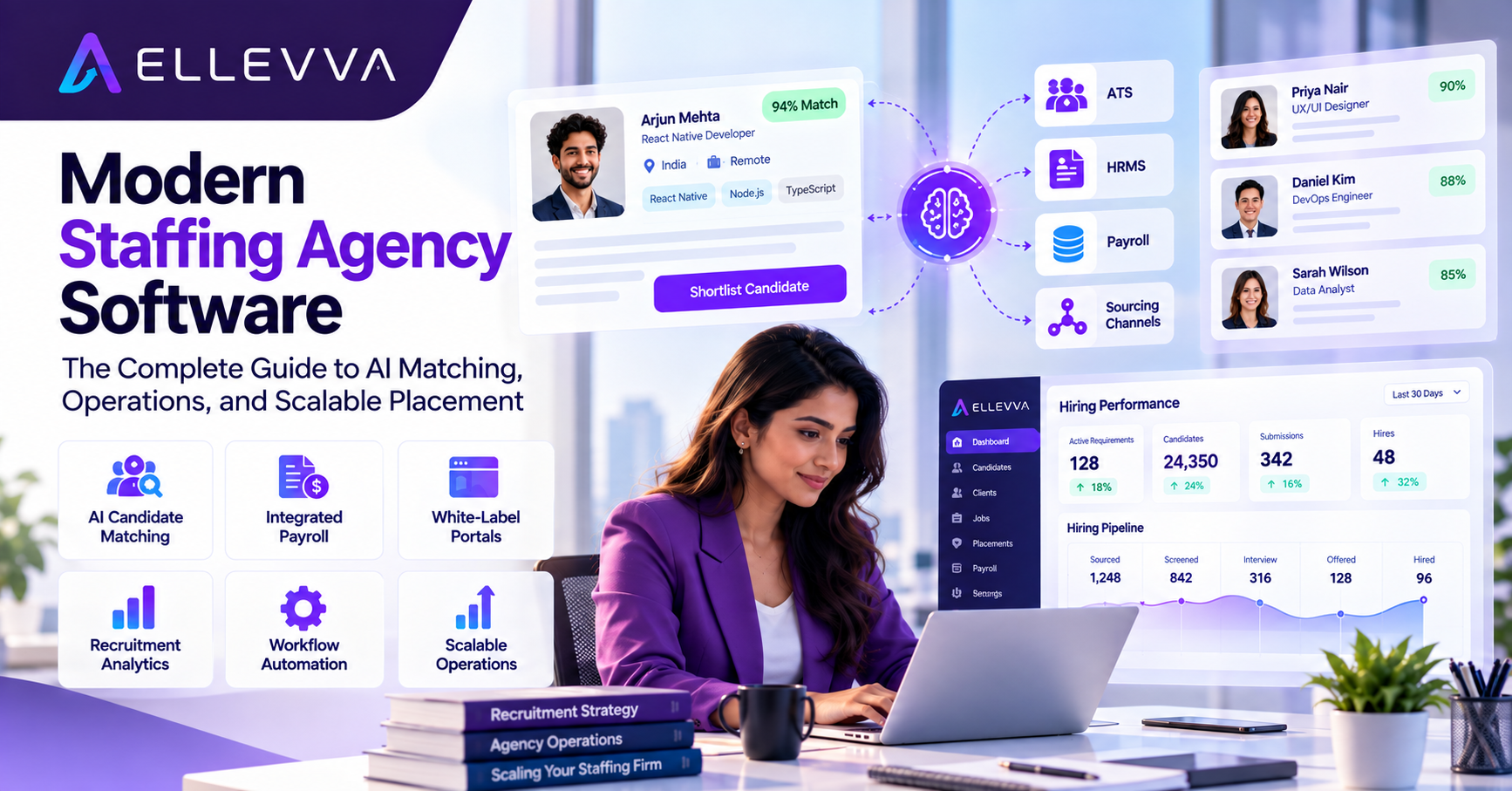
In an increasingly competitive talent landscape, staffing agencies, executive search firms, and enterprise recruiting teams face a shared mandate: deliver high-caliber candidates at unprecedented speed while keeping operational overhead lean. Legacy applicant tracking systems (ATS) and fragmented spreadsheets no longer suffice. When candidate profiles sit siloed across disparate databases and recruiters spend hours manually parsing resumes, the resulting friction creates compounding operational delays that directly erode revenue margins.
Modern recruitment demands an integrated approach. From front-office sourcing to back-office payroll integration, forward-looking staffing agencies are re-architecting their tech stacks around intelligent automation. In this guide, we explore how modern staffing firm software, AI-driven candidate matching, structured technical vetting, and consolidated operational dashboards help recruitment businesses eliminate hiring friction, accurately assess specialized talent, and scale client placements.
The True Cost of Hiring Delays in Agency Staffing
Speed is the primary currency of recruitment. When a client issues an urgent requisition—whether for a contingent technical project or a permanent leadership position—the agency that submits top-tier, verified candidates first almost invariably wins the placement fee. Conversely, prolonged placement cycles carry steep hidden costs.
1. Direct Revenue Loss and Missed Billable Hours
For temporary staffing agencies, every unfilled shift or vacant contractor seat translates directly into lost margin. When onboarding is delayed by days or weeks due to manual paperwork and disconnected credential verification, the agency permanently forfeits billable hours that cannot be recovered.
2. Candidate Drop-off and Talent Ghosting
Top candidates rarely remain on the market for more than ten to fifteen days. Lengthy screening intervals, delayed interview scheduling, and lack of transparency lead qualified applicants to accept competing offers. Fragmented systems leave candidates in the dark, hurting agency brand equity and lowering placement yields.
3. Recruiter Fatigue and Lower Productivity
When recruiters spend up to 60% of their workday wrestling with manual data entry, formatting resumes, updating disjointed tracker sheets, and chasing hiring managers for feedback, their capacity to build strategic candidate relationships and drive business development shrinks dramatically.
To eliminate the compounding cost of hiring delays, leading agencies are shifting away from fragmented point solutions toward centralized workforce operating systems that merge automated matching, robust ATS workflows, and operational analytics into a cohesive environment.
Core Pillars of High-Performing Staffing Firm Software
Choosing the right infrastructure requires balancing front-office candidate engagement, middle-office evaluation, and back-office administrative control. Whether operating a specialized boutique firm or a high-volume contingency staffing business, modern platforms must deliver several essential capabilities.
+-------------------------------------------------------------------------+
|                    MODERN STAFFING TECH STACK ARCHITECTURE              |
+-------------------------------------------------------------------------+
|  FRONT-OFFICE: AI Sourcing -> Intelligent Matching -> Candidate Portal  |
|  MIDDLE-OFFICE: Skills Vetting -> Interview Pipeline -> Assessments     |
|  BACK-OFFICE: Onboarding -> Time/Expense -> Payroll & Billing Sync      |
|  COMMAND LAYER: Real-Time Recruitment Analytics & Executive Dashboards  |
+-------------------------------------------------------------------------+
1. Intelligent ATS and AI Candidate Matching
Traditional keyword-matching engines look for exact string matches, frequently overlooking qualified candidates who format their resumes differently or use alternative technical terminology. In contrast, modern AI hiring software evaluates contextual talent signals—such as transferable skill clusters, career progression, industry context, project complexity, and historical performance data.
By leveraging improving hiring velocity with AI matching, staffing recruiters can instantly surface the top 5% of matching candidates from proprietary databases of tens of thousands of profiles within seconds of receiving a client requirement.
2. Unified Payroll Software and Timecard Integration
For contingent and temporary staffing operations, front-office recruiting and back-office accounting cannot remain disconnected. A robust software for temporary staffing agency workflows must cleanly interface with time-tracking, gross-to-net payroll calculations, multi-state tax compliance, direct deposits, and client invoicing. Effective payroll software for staffing agency operations automates gross margin calculations and synchronizes contractor timesheets directly with accounts receivable.
Automating the handoff from an accepted offer to digital onboarding and payroll setup prevents billing disputes, eliminates duplicate data entry, and ensures contingent workers receive prompt, accurate disbursements.
3. White-Label Portals for Clients and Candidates
Maintaining a professional, cohesive brand identity is essential when servicing enterprise accounts. Top-tier platforms offer white label staffing agency software capabilities, allowing firms to provide branded client portals for reviewing candidate submittals, approving timecards, and viewing live pipeline statuses. Branded talent portals similarly give candidates a self-service hub to manage applications, submit compliance documentation, and track payment schedules under your agency's distinct visual identity.
4. Collaborative Talent Networks and Coalitions
High-volume staffing demands broad access to verified talent. Modern agencies increasingly participate in shared sourcing ecosystems and tested recruits staffing agency software coalition models, where pre-vetted, validated talent profiles can be surfaced across allied networks without compromising proprietary client relationships. This coalition-style sourcing expands placement capacity during sudden demand spikes.
In-Depth Staffing Agency Software Comparison
When conducting a comprehensive staffing agency software comparison, it is vital to contrast traditional legacy models, fragmented point tools, and next-generation AI workforce platforms across operational criteria:
| Evaluation Metric | Legacy Staffing Software | Fragmented Point Solutions | Modern AI Workforce Operating Systems |
|---|---|---|---|
| Candidate Sourcing & Matching | Basic Boolean/keyword filters; manual review of large resume piles | Separate sourcing plugins with intermittent syncing | Real-time AI candidate matching scoring skill depth, context, and availability |
| Temp & Contingent Management | Basic shift scheduling; rigid, siloed add-ons | Third-party timecard apps requiring manual CSV exports | Native temp agency staffing software workflows, compliance verification, and automated payroll pipelines |
| Back-Office Integration | Clunky on-premise accounting connectors | API-dependent multi-tool sprawl prone to breaking | Unified data architecture connecting requirements directly to billing and gross margins |
| Branding & Client Experience | Generic, non-customizable client emails | Varied branding across third-party tools | Fully branded, white-label staffing agency software portals |
| Assessment & Technical Sifting | External manual links sent over email | Disconnected testing tools with separate logins | Integrated assessment flows benchmarked to target roles |
| Reporting & Visibility | Static monthly reports; lagging indicators | Fragmented dashboards across multiple logins | Live recruitment analytics dashboard tracking pipeline velocity and conversion |
Selecting a platform requires identifying whether your primary operational friction lies in candidate discovery, placement velocity, client collaboration, or back-office administration.
AI-Powered Technical Assessment: Sourcing Specialized Roles
As organizations race to build out their artificial intelligence and data infrastructure, staffing firms are tasked with filling increasingly sophisticated technical positions. Today's AI-powered recruitment stacks do more than search keywords; specialized AI hiring software evaluates technical depth to ensure candidates are genuinely qualified before recruiter submission.
Tools designed for talent discovery and technical screening—such as specialized AI hiring software systems in the market like GoPerfect and modern assessment platforms—enable agencies to evaluate candidate suitability with objective benchmarks rather than superficial resume buzzwords.
Practical Example: Assessing AI/ML Software Engineering Talent
Consider a scenario where an enterprise client asks your agency to source candidates for a competitive technical placement, such as an AI/ML software engineer or machine learning intern working on high-performance cloud data architectures like Snowflake. Evaluating these profiles manually presents unique challenges:
- Theoretical Understanding vs. Practical Execution: Setting up a practical benchmark, such as a Snowflake AI ML software engineer intern hiring test, requires assessing whether the candidate understands vector embeddings, data warehouse indexing, and distributed data pipelines rather than simply reciting boilerplate machine learning definitions.
- Code Efficiency and Query Optimization: Testing the candidate's grasp of data manipulation, SQL optimization, Python/C++ logic, and model lifecycle deployment under realistic compute constraints.
- Automated Objective Scoring: Utilizing standardized technical evaluation sandboxes before recruiter submission to ensure that every submittal sent to the client hiring manager represents a genuinely vetted, high-probability match.
When staffing software incorporates structured technical screening workflows, recruiters can objectively benchmark candidates against validated rubrics. This drastically improves the submission-to-interview conversion rate and builds deep trust with technical hiring managers.
Unlocking Operational Clarity with Recruitment Analytics
To maintain high margins and predictable placement cycles, staffing leaders require real-time pipeline visibility. Relying on end-of-month spreadsheets obscures bottlenecks until revenue has already slipped.
=========================================================================
              KEY RECRUITMENT OPERATIONS PERFORMANCE METRICS
=========================================================================
 [ Time-to-Submit ] ---> [ Submittal-to-Interview ] ---> [ Interview-to-Offer ]
        |                        |                           |
        v                        v                           v
 (Target: < 48 hrs)       (Target: > 45%)             (Target: > 60%)
=========================================================================
Implementing a centralized recruitment operations metrics dashboard allows firm leaders and practice managers to monitor operational health in real time:
- Pipeline Velocity by Stage: Track how many hours elapse between receiving a client requirement, generating matched profiles, and securing first-round interview slots.
- Recruiter and Account Manager Ratios: Measure recruiter activity versus actual candidate closures to identify coaching opportunities and distribute requisition workloads equitably.
- Placement Yield and Fall-off Rates: Monitor offer acceptance rates and 90-day retention metrics to ensure client satisfaction and safeguard fee revenue.
- Contingent Gross Margin Tracking: Maintain live visibility into loaded labor costs, pay rates, and client bill rates across active temporary placements.
With executive-level visibility, agency owners can proactively intervene when submittals stall, refine pricing structures, and scale high-performing business units with confidence.
Strategic Checklist: Choosing the Right Software for Your Staffing Firm
Before committing to a multi-year software agreement, staffing firm executives should evaluate prospective vendors against a comprehensive operational checklist:
- Contextual AI Matching Engine: Does the platform evaluate semantic skill relevance and career trajectory, or does it rely solely on rigid keyword searches?
- End-to-End Workflow Unification: Can your team manage sourcing, pipeline tracking, interview management, and onboarding without juggling five separate subscriptions?
- Contingent and Temp-Ready Tooling: Does the platform natively support temporary staffing workflows, compliance tracking, and direct integration with your preferred payroll software?
- Client-Facing White-Labeling: Can you present custom, branded talent dossiers and submittal portals that reinforce your agency’s premium market positioning?
- Security and Enterprise Compliance: Does the system provide role-based access controls, enterprise data protection, and compliant candidate record management?
- Actionable Real-Time Dashboards: Does leadership have access to real-time analytics on conversion rates, recruiter productivity, and time-to-fill trends?
Build a Faster, Smarter Staffing Practice
The staffing industry is moving past fragmented tools and manual processes. Agencies that embrace integrated, AI-native workforce platforms consistently outperform competitors by placing higher-quality talent in a fraction of the time.
By replacing disconnected spreadsheets with automated candidate matching, unified back-office workflows, and live pipeline analytics, your agency can eliminate hiring delays, improve client retention, and drive sustainable growth. To discover how a unified workforce operating system can transform your placement operations, explore Ellevva's AI recruitment solutions today.