
Recruitment Operations
12 min readRecruitment Operations Checklist: Synchronizing ATS, HRMS, and Sourcing Pipelines for Peak Performance
An actionable operational checklist for talent leaders and staffing firms to eliminate data silos, automate sourcing pipelines, and synchronize ATS, HRMS, and payroll systems for maximum hiring velocity.
By Dana Ostrowski · VP of RevOps, Ellevva ·
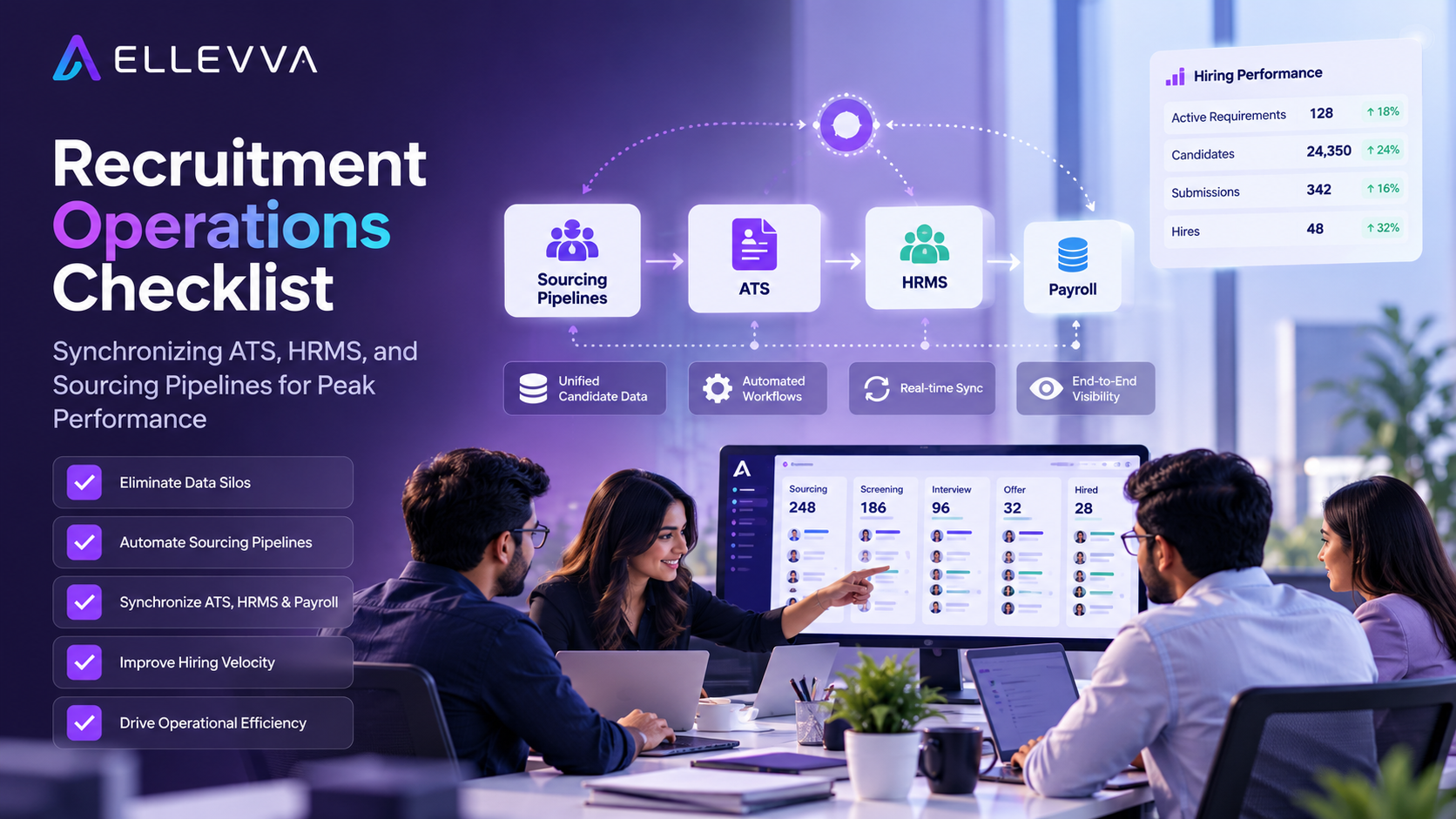
In high-growth enterprises and fast-paced talent agencies, recruiting performance hinges on data synchronization. When candidate sourcing channels, Applicant Tracking Systems (ATS), Human Resource Management Systems (HRMS), and back-office billing operate in isolation, friction accumulates rapidly. Recruiters re-enter data manually, candidates fall through status cracks, hiring managers wait weeks for feedback loops, and billing errors stall contractor onboarding.
Bridging these gaps requires more than isolated software point solutions—it demands a cohesive operational architecture. Implementing a unified, AI-powered workforce solutions strategy connects top-of-funnel discovery directly to back-office payroll, slashing cycle times while safeguarding data integrity.
This operational checklist serves as a blueprint for recruitment operations (RevOps/TalentOps) leaders, staffing firm executives, and enterprise talent acquisition teams seeking to audit, align, and automate their tech stack for peak performance.
Phase 1: Top-of-Funnel Sourcing and Ingestion Hygiene
The primary failure mode in modern talent pipelines begins at ingestion. Sourcing teams pull candidates from job boards, LinkedIn outreach, vendor coalitions, and internal talent pools. Without strict data governance, duplicated records and unverified profiles poison your database before candidate screening even starts.
Sourcing Ingestion Checklist
├── [ ] Standardized Role Taxonomy Mapping
├── [ ] Real-Time Resume & Profile Deduplication Rules
├── [ ] AI Enrichment of Missing Candidate Metadata
├── [ ] Autonomous Talent Pool Re-Engagement Triggers
└── [ ] Standardized Technical & Assessment Integration
1. Centralize Sourcing Channels with AI Ingestion
Modern sourcing requires continuous pipeline aggregation. Rather than scattering leads across spreadsheets and local drives, funnel every applicant into an AI-powered recruitment engine capable of parsing unstructured resume text, GitHub repositories, and portfolio links into structured talent schemas.
- Automated Data Enrichment: Ensure your ingestion pipeline immediately parses certifications, tech stacks, career progression, and availability indicators.
- De-duplication Protocols: Set deterministic matching rules (Email + Phone) paired with fuzzy probabilistic matching (Full Name + Current Employer) to prevent recruiters from cross-pitching active candidates.
- Intelligent Talent Rediscovery: Leading teams deploy AI hiring software—including modern algorithmic platforms like AI hiring software GoPerfect or proprietary intelligence engines—to mine legacy ATS databases before spending budget on fresh job board listings.
2. Standardize Assessment and Skill Verification
To keep pipeline velocity high, technical qualification should occur before hiring managers spend hours in exploratory conversations. High-volume and specialized technical pipelines (such as machine learning engineering roles evaluated via benchmarks akin to a Snowflake AI ML software engineer intern hiring test) must be integrated directly into your ATS.
- Trigger automated technical screenings upon application submission.
- Ensure test score payloads sync bidirectionally back to the candidate record.
- Establish automated pass/fail score gates that advance qualified talent directly into the hiring manager's review queue.
Phase 2: ATS-to-HRMS Data Handshake and Stage Alignment
The handoff between candidate acceptance in the ATS and employee/contractor provisioning in the HRMS is where hiring delays compound. Manual data re-entry at this stage is the leading cause of delayed start dates and compliance oversights.
| Pipeline Stage | Sourcing / ATS Action | HRMS / Back-Office Sync | Automation Check |
|---|---|---|---|
| Candidate Identified | AI Candidate Matching scores profile against job spec | Passive profile indexed; checks for prior tenure | Real-time score generation & duplicate block |
| Interview Completed | Scorecards submitted; feedback aggregated | Manager approval routing triggered | Webhook fires notification to hiring committee |
| Offer Accepted | Digital signature captured; background check initiated | New hire shell profile generated automatically | Bidirectional payload transfer via REST API |
| Pre-boarding | Compliance docs (I-9, W-4, direct deposit) collected | Payroll software for staffing agency receives bank & tax profile | Zero manual data re-keying verified |
| Day 1 Active | Candidate profile archived as "Hired" | Role-based provisioning & equipment delivery confirmed | Status change reflected across all dashboards |
3. Implement Unified Field Architecture
Discrepancies in data schemas create system errors. If your ATS tracks compensation as an hourly bill rate while your HRMS records annual base salary, data transformations will fail.
- Audit Data Dictionaries: Define standard naming conventions across ATS, HRMS, CRM, and ERP (e.g., role_title, department_id, pay_rate_hourly, exempt_status).
- Map Bidirectional Sync Triggers: Configure webhooks to fire on specific status changes (e.g., Offer Signed → Create Pending Employee Record).
- Establish a Golden Record Hierarchy: Declare which system acts as the single source of truth for each data point (ATS owns recruitment milestones; HRMS owns post-hire identity and compensation data).
Phase 3: Specialized Workflows for Temporary Staffing Agencies
Operating a staffing agency or contingent workforce consultancy introduces layers of complexity that corporate recruitment teams rarely face. High-volume placements, variable bill-pay spreads, contractor timesheets, and strict payroll deadlines demand purpose-built temporary agency staffing software.
4. Contractor Deployment and Shift Management
For agencies deploying nurses, warehouse logistics staff, field engineers, or contingent developers, software for temporary staffing agency workflows must synchronize real-time availability with incoming client shift orders.
- Dynamic Roster Synchronization: Maintain live visibility over candidate availability dates to prevent double-booking contractors across competing client accounts.
- Credential and Expiration Alerts: Automatically track licensure, safety training, and right-to-work expiries within your temp agency staffing software to lock deployment if documentation lapses.
- Verified Talent Alliances: Align with vetted industry groups—such as the tested recruits staffing agency software coalition frameworks—to cross-reference verified background checks and performance histories across agency networks.
5. Automated Back-Office & Payroll Software Integration
Staffing profitability hinges on the precision of your gross margin calculations. Disconnected timesheets create payroll disputes, cash flow bottlenecks, and invoice rejections.
- Timesheet-to-Payroll Pipelines: Integrate digital timesheets directly into your payroll software for staffing agency operations, verifying supervisor signatures before processing disbursements.
- Automated Margin Calculation: Ensure your system calculates net spread in real time, deducting statutory costs, workers' compensation insurance, and localized payroll taxes before generating customer invoices.
- Direct Invoice Generation: Eliminate billing lags by triggering client invoicing the moment contractor hours are approved in the HRMS.
Contractor Lifecycle Data Flow:
[ATS Sourcing & AI Match] ──> [Client Placement] ──> [Time & Attendance Tracking]
                                                            │
                                                            ▼
[Direct Client Invoice] <─── [Gross Margin Engine] <─── [Staffing Agency Payroll]
Phase 4: Platform Evaluation and Architectural Choices
When optimizing operations, talent leaders often conduct a comprehensive staffing agency software comparison to decide between building an integrated best-of-breed stack or adopting a single end-to-end workforce operating system.
6. The Staffing Firm Software Decision Matrix
Evaluate software candidates against scalability, integration depth, and operational visibility:
- All-in-One vs. Modular Architecture: While legacy point solutions require ongoing custom API maintenance, modern unified platforms natively integrate ATS, HRMS, CRM, and analytics into a centralized command center.
- White-Label Client and Talent Portals: Top agencies deploy white label staffing agency software (or white-label staffing agency software modules) to give corporate clients real-time visibility into open job requisitions, candidate shortlists, and timesheet approvals under their own brand identity.
- Contextual AI vs. Keyword Boolean Parsers: Ensure your staffing firm software utilizes semantic AI candidate matching that evaluates contextual career trajectories rather than basic keyword counts.
Phase 5: Pipeline Visibility and Analytics Governance
You cannot optimize what you do not measure. A unified data pipeline should culminate in a centralized recruitment analytics dashboard that provides immediate operational visibility across departments, recruiters, and client accounts.
7. Core Operational Health Metrics
To maintain peak performance, monitor essential recruitment operations metrics that highlight bottlenecks before they impact the bottom line:
- Time-to-Shortlist (TTS): The duration between requisition intake and the delivery of the first AI-scored candidate slate. (Target: < 48 hours for standard roles).
- Stage-by-Stage Conversion Ratios: Track attrition between Sourced → Screened → Client Submission → Interview → Offer. Significant drops between submission and interview indicate poor calibration or inaccurate matching algorithms.
- System Integration Failure Rate: The percentage of webhook or API sync errors occurring between ATS, HRMS, and payroll endpoints. (Target: < 0.1%).
- The True Cost of Hiring Delays: Quantify the business impact of vacant seats and slow candidate throughput. Prolonged requisitions result in missed revenue targets, recruiter burnout, and candidate drop-off to competing offers.
Cost of Delay = (Annual Revenue Generated by Role / Working Days per Year) × Days Requisition Remains OpenTracking this formula empowers talent leaders to justify investments in automated, AI-driven recruitment workflows that accelerate time-to-fill.
Operational Health Dashboard Overview
┌─────────────────────────────────────────────────────────────┐
│                     HIRING COMMAND CENTER                   │
├──────────────────┬──────────────────┬───────────────────────┤
│  Active Roles:   │  Time to Hire:   │ Offer Acceptance Rate:│
│       142        │     18 Days      │          92%          │
├──────────────────┴──────────────────┴───────────────────────┤
│ Pipeline Health:                                            │
│ • Sourcing to Shortlist Conversion:  46% [On Track]         │
│ • ATS-HRMS Data Sync Health:         99.9% [Nominal]        │
│ • Average Contractor Billing Lag:    1.2 Days [Optimal]     │
└─────────────────────────────────────────────────────────────┘
The Complete 30-Day Operational Audit Checklist
Use this tactical checklist to systematically audit your organization's recruitment infrastructure over the next 30 days:
Week 1: Data Audit & Deduplication
- ☐ Export and analyze recent candidate records across all sourcing platforms.
- ☐ Identify duplicate rates and configure strict de-duplication rules in your ATS.
- ☐ Cleanse legacy talent databases using automated profile enrichment tools.
- ☐ Review standardized job family definitions and compensation tier mappings.
Week 2: Integration & API Stress Testing
- ☐ Audit webhook triggers between ATS, HRMS, and candidate assessment tools.
- ☐ Conduct end-to-end mock hiring tests (Application → Interview → Offer → Employee Provisioning).
- ☐ Validate timesheet data pipelines into your payroll software for staffing agency accuracy.
- ☐ Test exception handling: Ensure failed API calls generate instant alerts to operations teams.
Week 3: Workflow Automation & AI Calibration
- ☐ Deploy semantic AI candidate matching to automate initial resume screening.
- ☐ Configure auto-scheduling workflows for hiring managers and recruiters.
- ☐ Review self-service portals (client dashboards, candidate profile trackers).
- ☐ Standardize technical assessment pass/fail routing to remove recruiter bottlenecks.
Week 4: Analytics Alignment & Team Enablement
- ☐ Consolidate reporting into a single recruitment analytics dashboard.
- ☐ Train recruiters on standardized pipeline stage hygiene and data logging.
- ☐ Establish weekly pipeline review cadences focusing on velocity bottlenecks.
- ☐ Measure reduction in cycle times and calculate cost-of-hire savings.
Elevating Recruitment Operations with an Intelligent Workspace
Disconnected hiring stacks place an invisible tax on growing organizations. When your ATS, HRMS, and sourcing pipelines operate as isolated silos, your team expends valuable bandwidth on administrative upkeep rather than building meaningful candidate relationships and closing top-tier talent.
By uniting candidate discovery, intelligent matching, and back-office synchronization into a single, automated operating system, modern enterprises and staffing agencies can cut hiring cycles by up to 60% and significantly reduce cost-per-hire.
Ready to transform your recruitment operations and unlock end-to-end pipeline visibility? Take the next step to explore Ellevva's flexible pricing plans and discover how our AI-powered workforce platform unifies your talent operations from requirement to successful closure.