
Recruitment Operations
14 min readHow Pre-Vetted Talent Pools Eliminate Resume Screening Bottlenecks and Accelerate Technical Hiring Cycles
Discover how pre-vetted talent pools and intelligent recruitment software eliminate resume screening bottlenecks, reduce time-to-hire, and streamline technical recruitment across global markets.
· VP of RevOps, Ellevva ·
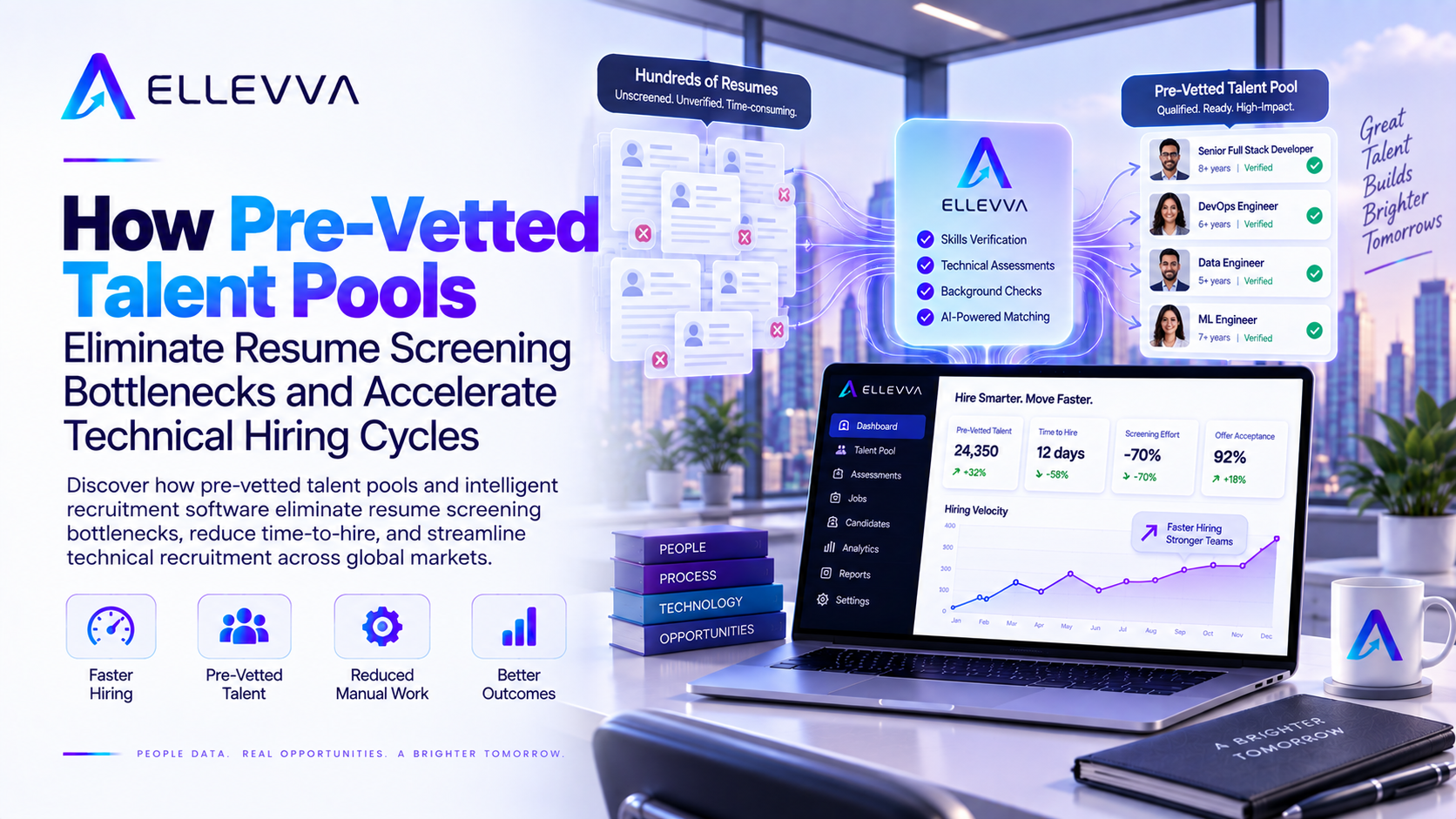
In modern technical recruitment, the traditional hiring funnel is fundamentally broken. When engineering leaders post an open role for a specialized developer or architect, recruiters are routinely flooded with hundreds—sometimes thousands—of inbound applications. A staggering percentage of these applicants do not possess the core technical competencies, architectural experience, or communication standards required for the position.
This avalanche of unqualified applications creates an unsustainable resume screening bottleneck. Highly paid engineering managers lose dozens of productive coding hours parsing PDFs, conducting redundant preliminary technical screens, and evaluating unverified claims. Meanwhile, prime candidates receive competing offers and drop out of lengthy pipelines.
To overcome these operational hurdles, forward-thinking hiring teams and agencies are abandoning reactive resume filtering in favor of pre-vetted talent networks powered by modern intelligent systems. By integrating pre-evaluated talent pools into their workflows, organizations can eliminate initial screening friction and compress engineering hiring cycles from months into single-digit days.

The Real Cost of Resume Screening Bottlenecks in Technical Hiring
Technical recruitment differs significantly from general hiring. Evaluating whether a candidate is genuinely proficient in distributed systems, modern microservices, or specific cloud architectures cannot be accomplished through traditional keyword scanning alone. Conventional resume screening suffers from several critical vulnerabilities:
- Keyword Stuffing and Inaccurate Resumes: Candidates frequently optimize their CVs with trendy buzzwords, making unqualified applicants appear viable on paper.
- Engineering Bandwidth Drain: When non-technical recruiters pass candidates who lack fundamental problem-solving depth, engineering managers must conduct repeated technical interviews, stalling product roadmaps.
- Candidate Drop-Off (Pipeline Decay): Top-tier software developers remain on the market for an average of just 10 to 14 days. If your initial screening and assessment phase takes three weeks, your team loses access to top-decile talent.
- Context Switching Costs: Recruiter productivity plummets when teams juggle disconnected spreadsheets, legacy applicant tracking systems, and fragmented candidate notes.
When evaluating recruitment operations metrics, high submission-to-interview ratios combined with low interview-to-offer ratios highlight a broken top-of-funnel filter.
What Are Pre-Vetted Talent Pools?
Unlike passive resume databases or job board scrapers, a pre-vetted talent pool is an organized network of verified professionals whose technical competence, domain background, practical problem-solving capabilities, and communication fluency have been rigorously assessed before a formal role requirement is opened. When a company requires a dedicated backend engineer or cloud specialist, the recruitment workflow shifts from an open-ended search to targeted matching against verified signals. This replaces manual resume parsing with deterministic qualification.
The Multi-Stage Verification Framework
A robust pre-vetting framework typically incorporates three distinct evaluation layers:
- Algorithmic & Technical Assessment: Practical coding evaluations, architectural design exercises, and real-world system debugging tasks rather than basic syntax quizzes.
- Behavioral & Communication Benchmarking: Evaluating cross-functional collaboration, async communication discipline, and stakeholder management skills.
- Background & Domain Verification: Validating production-level experience, previous project ownership, and security clearances where applicable.

Key Factors That Can Reduce Time to Hire
When leadership asks how to reduce the time to hire, organizations must examine where delays accumulate. Across industries, time-to-hire is rarely prolonged by the final decision-making meeting; it is prolonged by latency in early screening, scheduling friction, and misalignment between hiring managers and talent sources.
Let’s analyze the primary factors that can reduce time to hire across complex technical pipelines:
| Bottleneck Stage | Traditional Approach | Pre-Vetted & Intelligent Platform Model | Efficiency Gain |
|---|---|---|---|
| Sourcing & Discovery | Manual outbound cold messaging across LinkedIn; job board postings | Instant access to verified, available talent pools | 70% reduction in sourcing latency |
| Initial Screening | Reading hundreds of unverified resumes; 30-min recruiter phone screens | Profile verification, validated skills scores, and availability data | 85% reduction in manual screening time |
| Technical Validation | Engineering leads spend 5–10 hours per week on early-stage technical screens | Standardized, verified technical benchmarks completed in advance | 60% reduction in internal engineering hours spent |
| Interview Scheduling | Back-and-forth emails between candidates and multiple panel interviewers | Automated calendar syncing and centralized pipeline visibility | 50% faster stage-to-stage progression |
| Compliance & Onboarding | Fragmented document collection and manual contract handling | Automated onboarding workflows and compliance checks | 40% reduction in closure-to-start time |
By systematically removing manual screening steps, organizations routinely achieve a 60% faster time to hire while lowering overall cost per hire.
Sourcing Global Talent in Software: Expanding Beyond Regional Constraints
Engineering leadership faces a persistent challenge: local talent shortages drive up compensation benchmarks while limiting the speed of technical execution. Consequently, sourcing global talent in software has transitioned from an experimental tactic to a core operating strategy. Building international engineering teams across Latin America, Eastern Europe, Asia, and North America allows companies to achieve continuous development velocity and tap into specialized domain expertise. However, global hiring introduces significant screening complexity:
- Evaluating credentials and technical pedigree across unfamiliar universities and regional enterprises.
- Ensuring reliable English communication and alignment with distributed agile workflows.
- Managing cross-border compliance, contracts, and payroll orchestration.
By leveraging pre-vetted international networks with over 50,000+ verified global talent profiles covering 120+ technologies, engineering organizations bypass geographical friction entirely. Hiring managers review candidates who have already demonstrated their ability to deliver production-grade code within distributed engineering teams.
The Evolution of the Staffing Agency Software Market
The broader staffing agency software market is undergoing a foundational transition. Historically, legacy recruitment software functioned primarily as a static digital filing cabinet—an applicant tracking system (ATS) designed merely to store contact cards and track notes. Today, modern staffing agency software solutions have evolved into unified workforce operating systems that merge AI-driven matching, pipeline orchestration, compliance tracking, and automated candidate communications into a single interface.
Why Unified Platforms Outperform Point Solutions
When recruitment firms and internal talent teams rely on disconnected software stacks—using one tool for sourcing, another for skills testing, a third for applicant tracking, and a fourth for client invoicing—critical candidate data falls through the cracks. Modern platforms provide an integrated command center where teams monitor the entire journey from requirement posting to candidate placement. Understanding how AI matching improves hiring velocity helps recruitment leaders understand why automated skill-and-availability scoring delivers dramatically higher closure rates than manual keyword searches.
Cross-Industry Adaptations
- Healthcare & Clinical Operations: Just as engineering teams rely on verified coding benchmarks, healthcare facilities deploy nurse staffing agency software, specialized nursing staffing agency software, and healthcare staffing agency scheduling software (including platforms like *SaaS staffing agency software CarePro*) to automate credentialing, license verification, shift scheduling, and compliance management.
- Dental Practices: Specialized dental staffing agency software matches hygienists and dental assistants based on localized clinical certifications and immediate practice availability.
- Event & Hospitality Staffing: Dynamic event staffing agency software coordinates on-demand staff allocations, shifts, and high-volume check-ins across venues.
- Software Engineering & Technology Staffing: Agencies specializing in placing staffing agency software engineer talent utilize purpose-built staffing agency software development platforms equipped with technical benchmarking and automated pipeline intelligence.
- Back-Office Operations: Comprehensive recruitment suites incorporate integrated staffing agency billing software, connecting timesheets, billable client hours, and candidate disbursements seamlessly.
Across every sector, the core principle remains identical: replacing manual credential checks with structured, automated pre-verification and unified operational software.
How Pre-Vetted Talent Networks Accelerate the Engineering Hiring Cycle
To understand the operational advantage of pre-vetted networks in technical recruitment, let's trace the candidate journey from the initial requirement to successful onboarding.
┌────────────────────────────────────────────────────────────────────────┐
│                      THE ACCELERATED HIRING CYCLE                      │
└────────────────────────────────────────────────────────────────────────┘
                                    │
                                    ▼
 1. Post Requirement  ──►  Define role parameters, stack (e.g., Go/React),
                           seniority, and working time zones.
                                    │
                                    ▼
 2. Instant Matching  ──►  AI-assisted matching pairs requirements against
                           pre-vetted candidates with validated benchmarks.
                                    │
                                    ▼
 3. Focused Pipeline  ──►  Skip preliminary technical screens; proceed directly
                           to culture fit and deep architectural review.
                                    │
                                    ▼
 4. Rapid Closure     ──►  Transparent tracking, automated offer management,
                           and seamless onboarding.
1. From Open Requisition to Match in Hours, Not Weeks
Instead of waiting weeks for inbound applications to trickle in from job boards, hiring teams receive a curated shortlist of pre-screened professionals within 24 to 48 hours. Each profile contains verified skill ratings, code sample repositories, previous production impacts, and clear availability timelines.
2. Eliminating the Redundant First-Round Technical Screen
In a traditional process, engineering team leads spend 30 to 45 minutes per candidate conducting basic coding exercises or algorithm checks. With pre-vetted talent, these fundamental checks have already been executed and standardized. Hiring managers can focus their internal interview stages on deep-dive project discussions, system design challenges specific to the company's product, and cultural alignment.
3. Boosting Offer Acceptance Rates
Top candidates frequently decline offers when the hiring process drags out or lacks transparency. Pre-vetted platforms establish clear expectations regarding compensation, working hours, and technical stack preferences before candidates enter the interview stage. This alignment drives average offer acceptance rates above 90%.
Best Practices for Implementing Pre-Vetted Talent Workflows
For engineering leaders and talent acquisition teams looking to transition to pre-vetted talent models, consider the following actionable strategies:
1. Define Precise Technical Competency Rubrics
Before tapping into a pre-vetted network, clarify the non-negotiable competencies versus nice-to-have skills for your open roles. When requirements are articulated around concrete deliverables (e.g., "Experience scaling PostgreSQL to 100k writes/sec") rather than generic years of experience, matching engines can return hyper-relevant candidates.
2. Consolidate Your Recruitment Software Stack
Avoid operating across siloed communication channels. Ensure your sourcing platform, ATS workflows, and interview feedback loops are centralized within a unified workspace. This gives recruiters, hiring managers, and HR complete visibility into pipeline velocity and recruiter productivity.
3. Streamline Internal Interview Panels
Even with pre-vetted talent, an internal pipeline with five or six repetitive interview rounds will cause candidate drop-off. Restructure your internal interview stages into two or three focused conversations:
- Technical Deep Dive / System Architecture (60 mins)
- Team Collaboration & Culture Alignment (45 mins)
- Leadership / Final Alignment (30 mins)
4. Track Operational Velocity Metrics
Monitor key recruitment performance indicators continuously. Measure your average time-to-shortlist, submission-to-interview ratio, interview-to-offer ratio, and total days-to-closure. Identifying and addressing friction points in real-time ensures your hiring engine remains agile.
The Future of Technical Talent Acquisition
The days of manual resume screening, keyword-stuffed PDFs, and grueling 60-day engineering hiring cycles are drawing to a close. As global remote collaboration becomes the industry standard, competitive advantage belongs to organizations that can identify, evaluate, and onboard high-caliber technical talent with speed and precision.
By leveraging pre-vetted talent networks supported by comprehensive, intelligent recruitment software, companies eliminate costly administrative bottlenecks, protect their engineering teams' productive hours, and scale high-performing software teams with total confidence.
Ready to Streamline Your Technical Hiring?
Stop losing valuable engineering time to unverified resumes and manual screening pipelines. Discover how AI recruitment solutions for staffing and enterprise teams provide instant access to 50,000+ pre-vetted global professionals and end-to-end pipeline visibility to help your organization close roles faster.