
Recruitment Operations
10 min readThe Modern Staffing Agency Tech Stack: How Specialized Software and AI Slash Time-to-Hire
Discover how modern staffing agency software, intelligent scheduling, back-office automation, and hiring analytics help recruitment firms reduce time-to-hire across IT, healthcare, and temporary staffing sectors.
By Dana Ostrowski · VP of RevOps, Ellevva ·
The global recruitment industry has reached an inflection point where speed, operational accuracy, and talent precision dictate market share. Whether placing specialized technical talent, dispatching per diem nurses, or managing industrial shift rosters, recruitment firms can no longer rely on disconnected spreadsheets and legacy relational databases. Today's high-performing firms build their operational foundation on purpose-built staffing agency software ecosystems designed to automate routine coordination, connect front-office candidate engagement with back-office billing, and dramatically accelerate candidate placement.
Understanding how to structure this technology stack—across sector-specific placement models, back-office accounting, workforce scheduling, and global talent pipelines—is essential for any agency aiming to scale sustainably while maintaining high client satisfaction.
The Architecture of Modern Staffing Agency Software
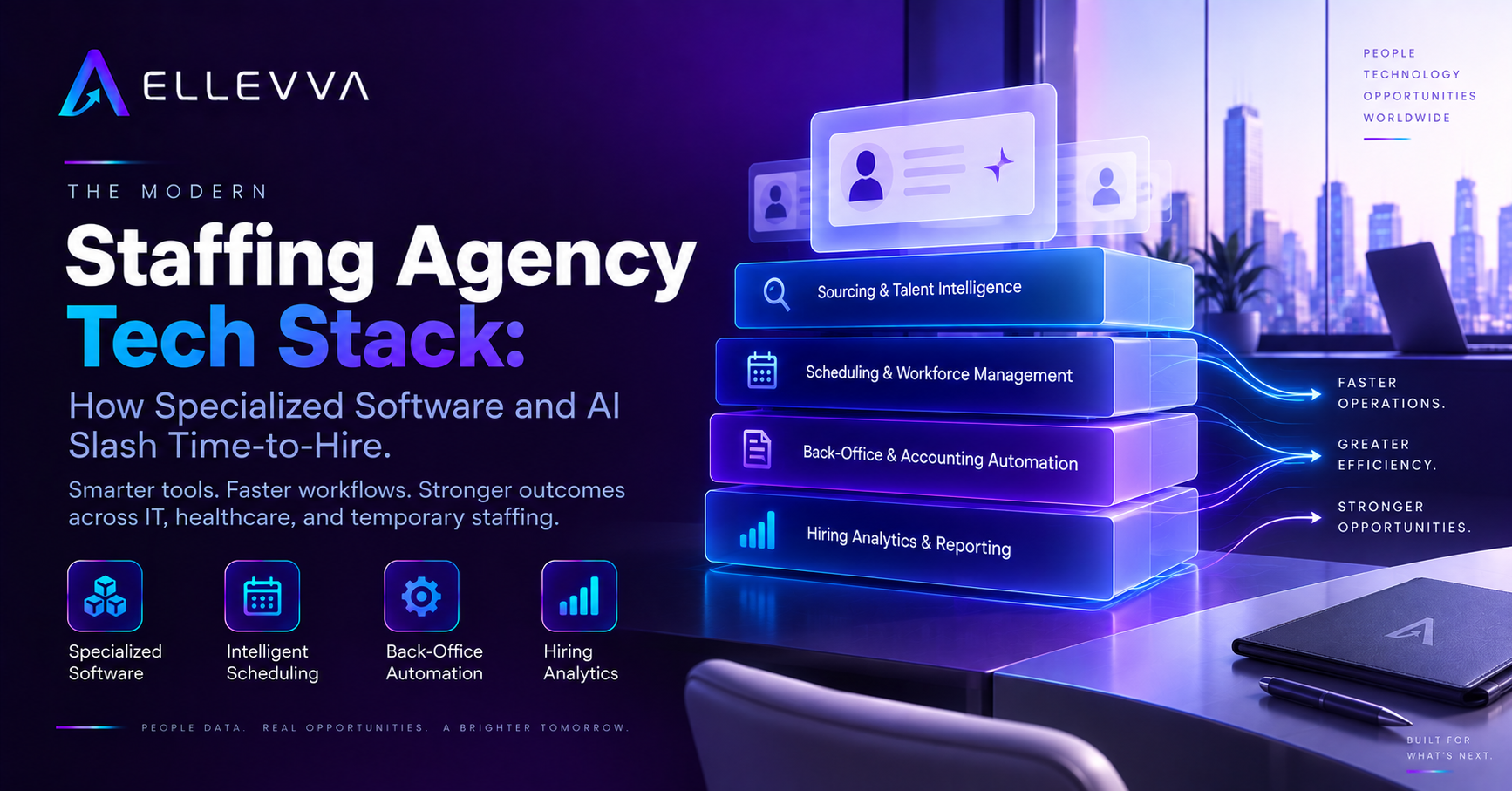
Traditional applicant tracking systems (ATS) were designed as static digital filing cabinets: they collected resumes, recorded candidate status changes, and stored basic notes. In contrast, comprehensive modern staffing agency platforms operate as full-fledged workforce operating systems. They combine four interconnected functional layers:
- Candidate Sourcing & AI Matching: Ingesting verified candidate profiles, scoring contextual skill alignment against job requirements, and ranking candidates based on historical placement performance and live availability.
- Front-Office Operations: Managing client requisitions, automated candidate communications, multi-stage interview coordination, and offer workflows.
- Middle-Office Scheduling & Dispatch: Allocating shifts, handling real-time calendar updates, and managing credential verification.
- Back-Office Accounting & Payroll: Tracking billable hours, calculating split commissions, handling gross margin analytics, and generating payroll files.
When these layers operate in silos, agencies suffer from data fragmentation, delayed closures, and lost candidate momentum. Unifying these motions under modern AI-powered recruitment solutions allows staffing teams to eliminate redundant administrative steps and focus their energy on candidate relationships and strategic client advisory.
Niche Demands: Engineering, Healthcare, and Temp Staffing

Different industry verticals impose radically different operational constraints on recruitment agencies. A tech-focused agency operates under long sales cycles and deep competency vetting, whereas a medical staffing firm operates under strict statutory licensing constraints and rapid shift filling.
+-----------------------------------------------------------------------------------------+
|                                 STAFFING PLATFORM MATRIX                                |
+-----------------------------+-----------------------------+-----------------------------+
| Tech & Engineering          | Healthcare & Clinical       | Temp & Industrial           |
+-----------------------------+-----------------------------+-----------------------------+
| - Deep tech stack taxonomy  | - License & credential checks| - On-demand shift dispatch  |
| - Verified coding profiles  | - Shift/roster management   | - Geofenced mobile clock-in |
| - Global borderless sourcing| - Clinical compliance audit | - High-volume time & payroll|
+-----------------------------+-----------------------------+-----------------------------+
1. The Engineering & Software Staffing Agency
Operating as a specialized staffing agency for software engineers requires tools capable of parsing multidimensional technical competencies. Standard keyword searches often fail because matching a distributed systems architect requires understanding frameworks, cloud architecture experience, asynchronous programming paradigms, and repository contributions—not just counting mentions of "Java" or "Python".
Moreover, software staffing agency models increasingly rely on international sourcing pipelines. Through frameworks such as EWS global talent sourcing (Employer of Record, Workforce solutions, and Global Sourcing networks), agencies can source, vet, and place cross-border engineering teams without needing legal entities in every jurisdiction. Platforms supporting this workflow must maintain verified candidate signals across time zones, local compensation benchmarks, and compliance protocols.
2. Medical and Healthcare Staffing Agency Software
In healthcare recruitment, speed is literally a matter of critical care coverage. High-functioning healthcare staffing agency software must provide automated credentialing, tracking state board certifications, DEA licenses, immunization records, background checks, and continuing medical education credits.
Furthermore, medical staffing agency software must integrate dynamic calendar synchronization to manage per diem nurses, locum tenens physicians, and allied health professionals across rotating clinical shifts. If a credential expires mid-assignment, the software should automatically flag the compliance risk before the shift is dispatched.
3. Temporary and Contingent Staffing Solutions
Agencies handling high-volume contingent work require dedicated temp staffing agency software that prioritizes fast communication and mobile accessibility. Candidates in temporary industrial, hospitality, and event roles depend on immediate SMS and mobile app notifications for upcoming shift openings.
A temporary staffing agency software solution must incorporate intelligent staffing agency scheduling software that automatically alerts available pools of pre-screened talent, fills unassigned slots instantly, and enforces overtime thresholds to protect agency margins.
Back-Office Synchronization: Payroll and Accounting Integration
Front-office placement velocity creates immediate operational friction if back-office accounting cannot keep pace. One of the most common failure points for growing recruitment agencies is the gap between logged candidate hours and actual invoicing.
Staffing Agency Payroll Software Capabilities
Unlike standard corporate payroll, staffing payroll involves dynamic billing structures, varying state tax rules for mobile contractors, split commissions across multiple recruiters, and daily or weekly pay cycles. Robust staffing agency payroll software delivers:
- Automated Digital Timesheet Approvals: Integrating digital clock-ins directly into supervisor approval portals.
- Multi-Jurisdiction Tax Compliance: Managing withholding across remote and traveling workforces automatically.
- Contractor Direct Deposit & EOR Routing: Disbursing payments across direct contractors, 1099 workers, and W-2 temporary employees.
Staffing Agency Accounting Software Requirements
A tailored staffing agency accounting software setup handles complex revenue recognition models. This includes real-time gross margin calculations (bill rate minus pay rate, burden, workers' comp, and statutory overhead), multi-tiered commission tiers for account executives and sourcers, and automated client invoicing based on validated timesheets.
When payroll and accounting communicate seamlessly with the core ATS, financial leakage is prevented, and invoice dispute rates drop dramatically.
Evaluating Free vs. Enterprise Staffing Platforms
Early-stage recruiters and boutique agencies frequently investigate free staffing agency software to manage their initial candidate pipelines. While exploring free solutions is a natural starting point, agencies must evaluate the hidden trade-offs involved.
| Evaluation Criteria | Best Free Staffing Agency Software | Enterprise Workforce Operating System |
|---|---|---|
| Candidate Database Capacity | Restricted (often < 1,000 records) | Scalable (50,000+ verified global profiles) |
| AI Matching & Scoring | Basic boolean string search | Semantic match scoring & vector indexing |
| Scheduling & Dispatch | Manual email/calendar links | Automated SMS broadcast & calendar routing |
| Back-Office Integration | CSV exports / manual entry | Native payroll, invoicing, and ERP webhooks |
| Hiring Analytics & Visibility | Basic count dashboards | Real-time stage velocity, closure & ROI metrics |
| Compliance & Role Access | Single admin, no role permissions | Granular role-based access & SOC2 compliance |
For a solo recruiter starting out, open-source or entry-level free tiers can help organize contacts and track basic interview stages. However, as placement volume grows, the manual data reconciliation required by disconnected free tools quickly consumes recruiter bandwidth.
Transitioning to a unified platform eliminates data silos, automates repetitive outreach, and provides the visibility required to scale revenue.
How to Reduce Time to Hire: Strategies and Operational Metrics
Time-to-hire is the single most critical performance indicator for staffing firms. A lengthy recruitment cycle damages candidate conversion rates, inflates operational costs, and risks losing top talent to competitors. Understanding how to reduce time to hire requires identifying and dismantling bottlenecks at each phase of the recruitment lifecycle.
1. Implement Semantic AI Profile Matching
Manual resume screening remains the largest bottleneck in recruitment operations. When recruiters must manually review hundreds of incoming applications, high-fit candidates sit uncontacted for days. Automated matching engines score candidate profiles against client job requisitions instantly based on practical skill adjacencies, verified experience levels, and historical interview performance.
2. Leverage Hiring Analytics Software
To optimize a pipeline, you must measure it accurately. Modern hiring analytics software tracks pipeline velocity across every hiring stage, exposing where candidates drop off or stall.
By continuously monitoring critical recruitment operations metrics—such as requirement-to-submission time, submission-to-interview ratio, interview-to-offer rate, and offer acceptance percentage—agency leadership can identify underperforming channels or sluggish hiring managers.
Requirement Published
        │
        ▼ (Target: < 24 Hours)
AI Semantic Shortlist & Automated Outreach
        │
        ▼ (Target: < 48 Hours)
Recruiter Screen & Verified Skill Review
        │
        ▼ (Target: < 5 Business Days)
Client Interview Rounds (Structured Rubrics)
        │
        ▼ (Target: < 24 Hours)
Automated Offer Generation & Electronic Signing
        │
        ▼
Successful Closure & Onboarding Dispatch
3. Standardize Interview Pipelines and Feedback Loops
Unresponsive hiring managers are a primary contributor to delayed hiring cycles. Automated reminders, structured interview scorecards, and shared real-time candidate dashboards keep clients engaged and accountable. Setting clear SLAs (Service Level Agreements) for client feedback ensures candidates move smoothly from initial interview to offer letter.
4. Maintain Pre-Vetted Talent Pools
High-velocity agencies do not start sourcing from scratch when a new requirement is posted. By cultivating continuous talent communities within their core verticals (e.g., cloud engineers, ICU nurses, certified forklift operators), recruiters can dispatch pre-qualified profiles within hours of receiving a mandate.
Essential Checklist for Upgrading Your Staffing Stack
When evaluating new staffing technology or auditing your existing software architecture, ensure your system satisfies these operational requirements:
- ☐ Unified Command Center: Consolidates ATS, sourcing, candidate pipelines, and client accounts in a single interface.
- ☐ Automated Multi-Channel Communication: Reaches candidates instantly via WhatsApp, SMS, and email directly from the candidate profile.
- ☐ Configurable Workflow Stages: Adapts interview stages dynamically for contingent vs. direct-hire placements.
- ☐ Real-Time Pipeline Analytics: Provides instant visibility into recruiter output, submission-to-closure rates, and cost per hire.
- ☐ Seamless Ecosystem Integrations: Connects directly with background verification providers, accounting suites, and digital signature tools.
Scaling Your Agency With Intelligent Automation
As competition intensifies across technical, clinical, and temporary staffing markets, the agencies that dominate will be those that eliminate administrative latency. Equipping your recruiters with intelligent AI matching, integrated back-office operations, and transparent hiring analytics allows your agency to fill requirements faster, protect healthy gross margins, and deliver exceptional experiences to clients and candidates alike.
Ready to modernize your recruitment operations and accelerate hiring velocity? Discover how unified AI matching and pipeline automation can transform your workflows—explore Ellevva's flexible pricing plans and scale your staffing business today.