
Recruitment Operations
12 min readHow Modern Recruitment CRMs Align Hiring Managers, Recruiters, and Executives on Strategic Hiring Goals
Discover how modern recruitment CRMs unite hiring managers, talent acquisition teams, and executive leaders around unified workflows, data-driven hiring velocity, and measurable business outcomes.
· VP of RevOps, Ellevva ·
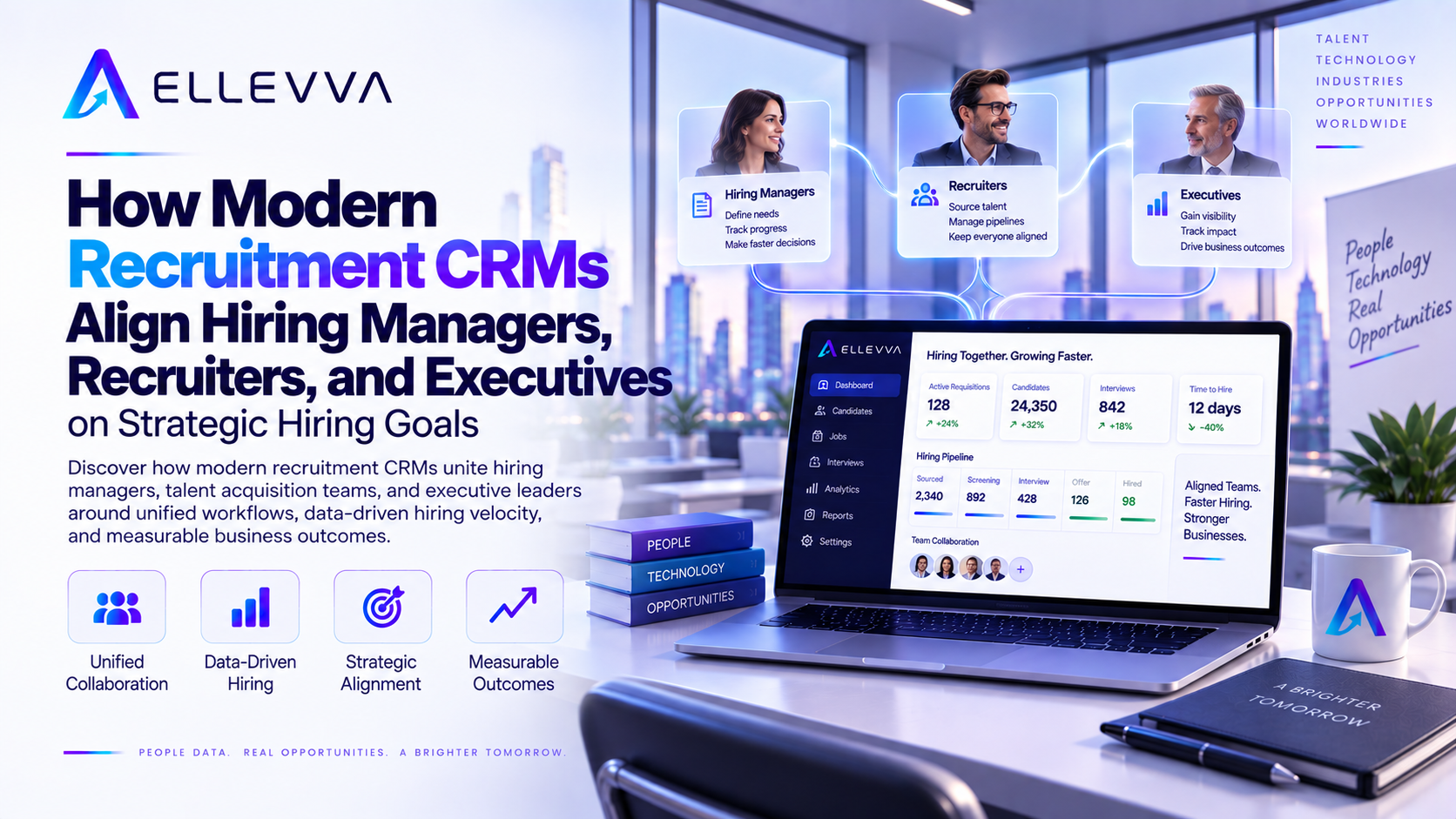
In high-growth organizations and competitive talent markets, hiring is no longer an isolated HR function. It is a core strategic lever directly tied to revenue growth, product roadmaps, customer satisfaction, and operational resilience. Yet in many companies and staffing agencies, hiring continues to suffer from structural friction: recruiters balance dozens of open requisitions in disparate spreadsheets; department hiring managers complain of slow feedback loops and misaligned candidate profiles; and executive leadership lacks transparent visibility into headcounts, operational budgets, and pipeline velocity.
This breakdown stems from fragmented tooling. When applicant tracking systems (ATS), customer relationship management (CRM) engines, back-office spreadsheets, and email threads operate in silos, alignment disintegrates.
Modern recruitment software bridges these divides. By establishing a single source of truth across candidate pipelines, communication histories, and operational metrics, contemporary recruitment CRMs transform hiring into a synchronized, high-velocity business operation.
Whether an enterprise is scaling a cross-border engineering division or a specialized agency is placing clinical talent across healthcare systems, understanding how to align recruiters, hiring managers, and executives is the key to unlocking sustainable hiring performance.
The Anatomy of the Hiring Disconnect
To understand why a centralized recruitment CRM is essential, it is necessary to examine how misalignments manifest across the three primary stakeholder tiers:
- Recruiters & Talent Acquisition Teams: Recruiters bear the operational weight of sourcing, outbound engagement, candidate qualification, interview coordination, and follow-ups. When forced to navigate fragmented databases and legacy portals, recruiter productivity drops. Sourcing efforts duplicate, candidate relationships cool down, and administrative overhead overwhelms strategic engagement.
- Hiring Managers & Department Heads: Department leaders focus on team capability, delivery deadlines, and technical or functional competence. When hiring managers lack real-time visibility into active candidate pipelines, they experience hiring as a black box. Feedback provided on interview scorecards often fails to recalibrate sourcing criteria upstream, resulting in repeat submissions of mismatched profiles.
- Executive Leadership & Finance: C-suite executives and financial officers view talent acquisition through the lenses of unit economics, headcount pacing, time-to-productivity, and revenue impact. Without consolidated reporting, leadership only discovers hiring bottlenecks after delivery schedules slip or agency placement fees balloon unexpectedly.
When these three groups operate without a unified system, time to hire stretches, candidate quality deteriorates, and cost per hire escalates. Bridging these perspectives requires unified technology that translates operational recruiting data into actionable insights for every stakeholder.
The Evolving Landscape of Staffing and Recruitment Software

The broader staffing agency software market has undergone a fundamental transformation. Historically, agencies and in-house teams relied on transactional ATS platforms that acted merely as electronic filing cabinets for resumes. Today, modern staffing agency software solutions merge ATS workflows, candidate relationship management, multi-channel engagement, and end-to-end workforce analytics into integrated platforms.
This shift reflects an understanding that recruitment is inherently dynamic. A modern CRM functions not just as a database, but as an operational operating system. In specialized sectors—such as staffing software development, niche tech recruitment, or high-volume agency models—the CRM unifies lead generation, client management, talent pooling, and back-office tracking in real time.
Furthermore, specialized SaaS ecosystems—ranging from enterprise recruitment platforms to specialized platforms like SaaS staffing agency software CarePro solutions—illustrate how workflow automation must adapt to industry-specific demands. Across all verticals, the underlying requirement remains constant: real-time synchronicity between those who source, those who evaluate, and those who govern.
+-------------------------------------------------------------------------+
|                    MODERN RECRUITMENT CRM ECOSYSTEM                     |
+-------------------------------------------------------------------------+
|                                                                         |
|  [Executive Layer]       - Revenue Forecasting & Placement Analytics    |
|                          - Headcount Pacing & Cost Allocation           |
|                                                                         |
|  [Manager Layer]         - Real-Time Candidate Pipelines & Scorecards   |
|                          - Feedback Calibration & Intake Alignment      |
|                                                                         |
|  [Recruiter Layer]       - AI Matching & Multi-Channel Sourcing         |
|                          - Automated Engagement & Workflow Velocity     |
|                                                                         |
|  [Back-Office Layer]     - Shift Scheduling & Credential Tracking       |
|                          - Integrated Invoicing & Billing Workflows      |
|                                                                         |
+-------------------------------------------------------------------------+
How Modern Recruitment CRMs Create Stakeholder Alignment
Modern recruitment CRMs resolve organizational friction by creating shared workflows, unified interfaces, and synchronized data layers tailored to each stakeholder's responsibilities.
1. Collaborative Job Scoping and Intake Workflows
Alignment begins before a single candidate is contacted. Traditional intake processes often consist of an informal briefing or an outdated job description pasted into an email.
A modern CRM structures the requisition intake process into an interactive digital workflow. Hiring managers and recruiters co-create competency rubrics, define non-negotiable technical skills, set compensation boundaries, and identify target companies or geographic regions. Because the CRM stores historical placement data, it can immediately inform both parties of talent availability, expected compensation ranges, and realistic sourcing timelines. This prevents misalignment from the outset.
2. Transparent Candidate Pipelines and Real-Time Visibility
Instead of asking for status updates via chat or weekly meetings, hiring managers and department leads can access role-specific dashboards. They can see exactly how many candidates have been sourced, screened, invited to technical interviews, or extended offers.
When a hiring manager reviews candidate profiles, interactive scorecards allow them to leave structured feedback tied to the original intake rubric. If three successive candidates are rejected for lacking a specific distributed systems architecture background, the CRM flags this pattern. Sourcing algorithms and recruiters immediately adjust their parameters, ensuring candidate pools recalibrate in hours rather than weeks.
3. Sourcing Global Talent and Specialized Engineering Profiles

As organizations scale remote and hybrid teams, sourcing global talent in software and technical engineering has become standard practice. Sourcing across international markets introduces complexities around time zones, varied educational frameworks, regional salary benchmarks, and compliance regulations.
When evaluating technical roles, a recruitment CRM dedicated to software engineering placements integrates with developer platforms, public repositories, and skill verification engines. Sourcing a dedicated staffing agency software engineer requires assessing specific programming languages, system design capabilities, and cultural fit. Advanced CRMs allow recruiters to build continuous global talent pipelines, nurturing relationships with engineers long before a requisition formally opens. Hiring managers gain immediate access to pre-vetted global shortlists, dramatically accelerating time-to-interview.
4. Vertical-Specific Workflows: Healthcare, Dental, and Event Staffing
Stakeholder alignment is not uniform across industries. Niche staffing firms face unique operational hurdles that standard corporate ATS platforms cannot address:
- Healthcare and Nursing Agencies: In clinical environments, matching involves rigid compliance mandates, active state licenses, BLS/ACLS certifications, and shift preferences. Utilizing dedicated nurse staffing agency software and specialized nursing staffing agency software ensures credential compliance before a candidate is ever submitted to a hospital unit manager. Furthermore, integrated healthcare staffing agency scheduling software connects real-time shift openings with available personnel, preventing understaffing and double-booking.
- Dental Staffing Agencies: Clinical practices operate on tight schedules where temporary hygienists or dental assistants are often required on short notice. Modern dental staffing agency software enables practice managers to request coverage digitally while recruiters broadcast opportunities instantly to pre-credentialed local professionals.
- Event and Hospitality Staffing: Large-scale venues experience high-volume fluctuations. Deploying robust event staffing agency software allows agency coordinators and event managers to align on venue headcount, check-in logistics, on-site time tracking, and instant role replacements.
By embedding sector-specific workflows—such as credential management, shift dispatching, and compliance verification—into the primary CRM, agencies ensure that client hiring managers and agency recruiters remain perfectly synchronized throughout execution.
Reducing Time to Hire Through Operational Alignment
One of the primary shared goals across recruiters, hiring managers, and executives is reducing hiring cycle duration without compromising candidate quality. Lengthy recruitment cycles lead to candidate drop-off, increased operational strain on existing teams, and lost business opportunity.
When exploring how to reduce the time to hire, organizations must identify the underlying operational levers. Modern recruitment CRMs directly optimize the primary factors that can reduce time to hire.
| Operational Bottleneck | Traditional Workflow | Modern Recruitment CRM Impact |
|---|---|---|
| Candidate Sourcing | Manual boolean searches across fragmented job boards | AI-powered matching against unified talent databases and global pools |
| Resume Screening | Manual file reviews, leading to days of delay | Automated profile scoring against structured role competencies |
| Interview Scheduling | Multi-day email exchanges across conflicting calendars | Self-service candidate scheduling synced with panel availability |
| Feedback Collection | Chasing managers for notes via chat and email | Automated scorecard reminders and in-platform rubric evaluations |
| Offer Approval | Disconnected email approvals and slow contract generation | Role-based automated approval workflows with digital e-signatures |
By eliminating administrative lag at each stage, talent teams leveraging modern recruitment software for staffing agency operations routinely reduce their time to hire by 40% to 60%. Discover how improving hiring velocity with AI matching systematically streamlines candidate discovery and initial qualification.
Bridging Front-Office Sourcing with Back-Office Operations
For staffing agencies and contingent workforce programs, alignment cannot stop at candidate placement. The front-office recruiting motion must connect seamlessly with middle-office scheduling and back-office finance.
A recurring point of friction in staffing organizations is the disconnect between placement agreements, timesheets, and invoicing. When recruiters negotiate contract rates in one tool while accounting bills clients from another, billing leakage and payroll errors occur.
Modern recruitment CRMs resolve this by integrating front-office candidate tracking with staffing agency billing software. Once a placement is finalized or a shift is completed:
- Approved hours flow automatically from scheduling and time-tracking modules into client billing profiles.
- Invoices generate based on contract terms, overtime rules, and agreed bill-rates without manual spreadsheet re-entry.
- Executive dashboards receive real-time updates on gross margins, contractor run-rates, and expected cash flows.
Connecting talent acquisition directly to financial workflows ensures that recruiters, account managers, operations specialists, and financial controllers operate from identical revenue and margin figures.
Executive Visibility: Moving from Tactical Data to Strategic Decisions
For executive leaders—CEOs, COOs, and CFOs—the true value of a modern recruitment CRM lies in data integrity and predictive visibility. When disparate teams use disconnected software, leadership reports must be manually compiled every quarter, presenting outdated historical summaries rather than live operational intelligence.
Modern recruitment CRMs provide executive command centers that track key recruitment operations metrics in real time:
- Pipeline Conversion Velocity: Tracking stage-by-stage drop-off rates across departments to identify whether delays stem from sourcing volume, screening criteria, or manager review bottlenecks.
- Recruiter Capacity and Output: Evaluating recruiter workloads, submission-to-interview ratios, and placement velocity to balance team resources effectively.
- Cost per Hire and Channel ROI: Analyzing which sourcing channels, global talent hubs, or external agencies yield the highest-performing, longest-tenured hires relative to acquisition spend.
- Workforce and Capacity Planning: Correlating active hiring pipelines against quarterly business goals to ensure headcount targets align with product rollouts and revenue forecasts.
With transparent analytics, executive discussions shift from troubleshooting hiring delays to making informed workforce investments that fuel corporate strategy.
Framework: How to Implement a Unified Recruitment CRM Strategy
Aligning three distinct stakeholder groups requires deliberate change management and structured technology adoption. Organizations seeking to modernize their recruitment CRM should follow a four-phase rollout:
Phase 1: Standardize Hiring Definitions and Rubrics
Before configuring software, convene talent leads and department managers to standardize job families, competency criteria, and stage milestones. Ensure terms like "qualified submission," "technical screen," and "final assessment" mean the exact same thing across all business units.
Phase 2: Integrate Front-to-Back Workflows
Eliminate duplicate data entry by ensuring your recruitment platform integrates natively with communication suites (email, calendar, Slack/Teams), HRIS platforms, and back-office billing software. Verify that candidate profiles flow seamlessly into employee records upon hire.
Phase 3: Implement Role-Based Dashboards
Configure dashboard views to match stakeholder responsibilities:
- Recruiters: Focus on daily candidate pipelines, automated outreach sequences, AI match scores, and pending tasks.
- Hiring Managers: Focus on active candidate submissions, one-click scorecard reviews, interview schedules, and stage-by-stage requisitions.
- Executives: Focus on headcount attainment, budget utilization, time-to-fill trends, and agency placement spend.
Phase 4: Establish Continuous Feedback Loops
Use monthly pipeline reviews to evaluate conversion rates and operational metrics. If hiring managers consistently reject candidates at the final round, revisit the initial intake rubric and recalibrate sourcing algorithms to close the gap.
Unlocking Collaborative Hiring Velocity
Hiring excellence is fundamentally an organizational capability, not an isolated recruiting task. When hiring managers, recruiters, and executive leadership operate in alignment—supported by transparent data, automated workflows, and unified communication—hiring becomes a competitive advantage.
Modern recruitment CRMs eliminate data silos, automate repetitive administrative tasks, and empower teams to source, evaluate, and onboard top talent faster. Whether your organization is placing specialized clinical staff across healthcare networks, scaling global software engineering teams, or managing complex contingent staffing operations, an integrated workforce platform provides the speed, clarity, and control required to succeed in modern talent markets.
Transform your hiring operations with AI-powered recruitment solutions from Ellevva. Unify your recruiters, hiring managers, and leadership on one intelligent platform to reduce time to hire and secure top global talent.