
AI Hiring
12 min readHow AI Matching Accelerates Hiring Velocity and Shrinks Enterprise Cycle Times
Discover how AI recruitment matching, predictive candidate scoring, and automated workflows dramatically boost hiring velocity, cut cycle times, and streamline talent operations for enterprise teams and staffing agencies.
By Priya Nandakumar · Head of Talent Science, Ellevva ·
Understanding the Friction in Traditional Enterprise Hiring Cycles
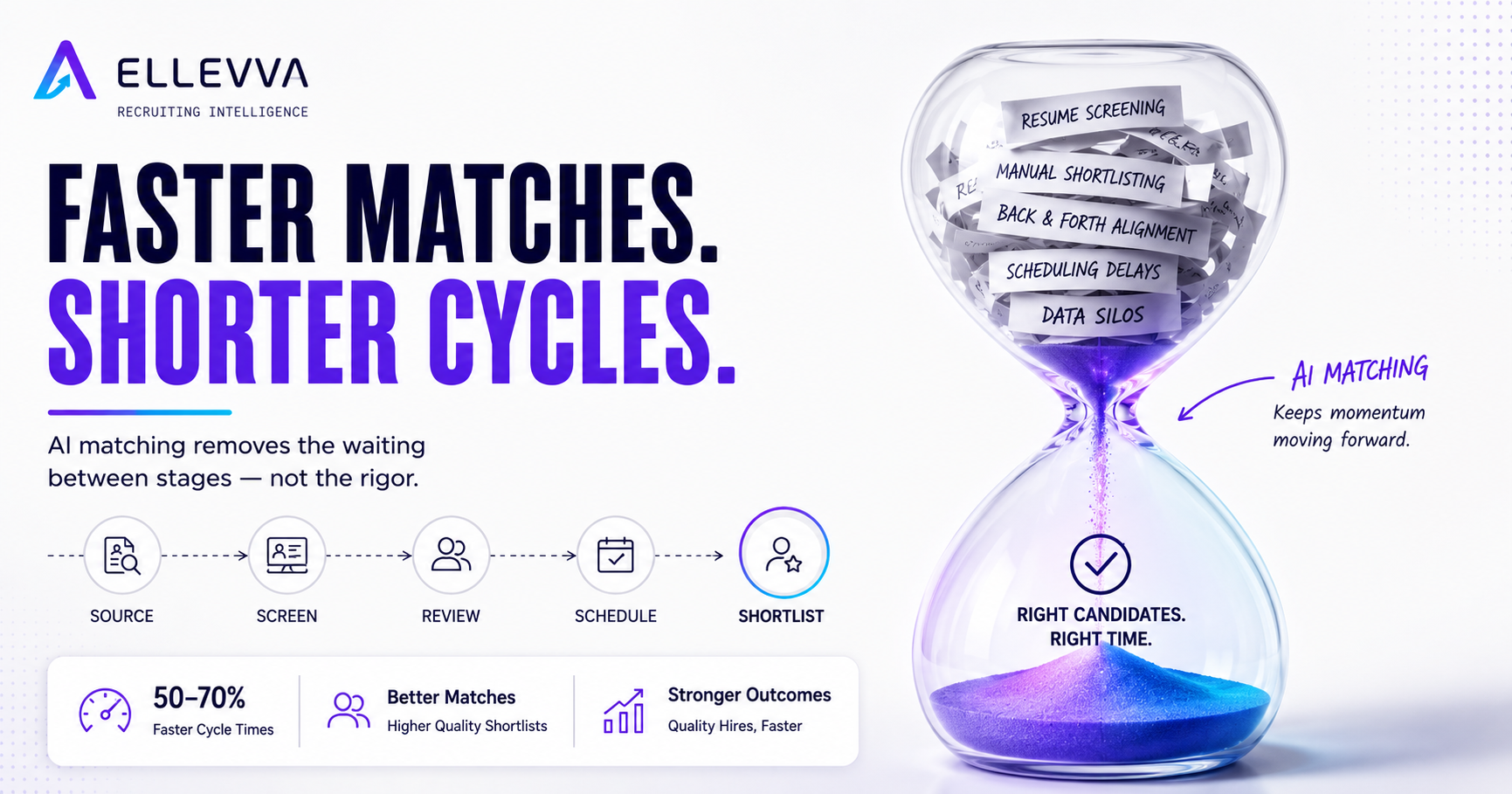
In hyper-competitive talent markets, recruitment delays carry severe financial and operational costs. When positions remain unfilled for 45 to 60 days, productivity plummets and high-caliber candidates accept competing offers before initial screening calls even conclude. Latency accumulates across manual profile screening, slow shortlist calibration between recruiters and hiring managers, disconnected point solutions that scatter data across resume databases, ATS platforms, and spreadsheets, and scheduling bottlenecks that create multi-week lags. When recruitment operations rely on piecemeal tooling, data lives in silos, and neither an enterprise recruiting department nor a fast-paced agency staffing software environment can scale if recruiters are trapped in administrative data entry instead of engaging qualified talent.
The Mechanics of Modern Candidate Matching Algorithms

At the core of hiring acceleration is the transition from static keyword searches to multi-dimensional candidate matching algorithms. Traditional systems rely on exact-phrase boolean strings and discard qualified candidates who describe the same skill differently. An AI recruiting platform instead leverages machine learning, contextual embeddings, and natural language understanding to evaluate fit holistically: semantic skill graphing maps technical skills and adjacent competencies rather than isolated terms; contextual experience and trajectory mapping weighs career progression, team scale, and project complexity; availability and intent signals prioritize candidates who are actively receptive instead of passive profiles; and continuous feedback loops recalibrate match accuracy as hiring managers accept or reject recommendations.
How AI Matching Directly Drives Faster Time to Hire
Adopting an AI powered recruiting platform removes friction across the pipeline. Instantaneous matching against verified talent networks replaces hours of boolean sourcing, cutting sourcing lead time by roughly 80%. Automated multidimensional fit scoring replaces manual resume review that once took three to seven business days with immediate shortlist generation. Unified scorecards replace scattered feedback across email and chat, compressing hiring-manager decisions into 24 hours. Automated, calendar-integrated candidate self-scheduling replaces manual calendar coordination, eliminating multi-day interview lags. Together, these gains let organizations achieve up to 60% faster time to hire and reduce cost per hire by as much as 40%.
Unifying Workflows: Specialized Capabilities for Staffing Agencies and Enterprises

While corporate talent acquisition teams focus on internal headcount, commercial recruiting agencies operate under extreme pressure to submit qualified talent before competitors, and high-growth firms require purpose-built software for staffing agency workflows. Whether operating as a boutique software engineer staffing agency or a global engineering vendor, AI matching evaluates code repositories, architectural competencies, and technical domain experience so recruiters present candidates who pass technical vetting on the first attempt. Automated staffing agency scheduling software coordinates interviews, onboarding, and shift allocation without dropped handoffs, while dedicated temporary staffing agency software tracks assignment durations, contract extensions, and credential expirations for contingent workforces. Seamless integration with staffing agency accounting software then ensures placed hours, bill rates, pay rates, margin tracking, and invoicing synchronize without double-entry errors, so consolidating front-office sourcing with back-office execution keeps the entire team focused on candidate engagement and placement.
Practical Framework for Implementing AI Matching in Enterprise Recruiting
Transitioning to an AI-driven recruitment model works best as a structured four-stage rollout: standardize job architecture and role taxonomy so competencies and required outputs are consistent across departments; leverage a pre-vetted global talent pool instead of starting every search from scratch on public job boards; implement automated manager shortlist reviews so hiring managers approve or reject AI-generated match summaries with a single click instead of sitting through weekly catch-up calls; and monitor full-funnel conversion analytics, tracking submission-to-interview and interview-to-offer ratios to catch whether a stalled stage stems from compensation misalignment, assessment delays, or interview panel availability.
Overcoming Common Concerns in AI-Driven Recruitment
As organizations adopt automated intelligence, leaders reasonably ask about fairness, oversight, and security. Leading platforms address algorithmic bias by scoring demonstrable capabilities, verified project outcomes, and standardized assessments while masking demographic factors during initial scoring. AI is not designed to replace recruiters — it automates low-value administrative burdens like resume parsing, initial data matching, and calendar coordination, freeing recruiters to build relationships, counsel hiring managers, and close top-tier candidates. Because recruitment platforms process sensitive personal and professional data, enterprise-grade solutions enforce role-based access controls, encryption at rest and in transit, and adherence to international privacy standards.
The Strategic Impact of Maximizing Hiring Velocity
When cycle times drop from 50 days to under 20 days, the benefits extend well beyond recruitment metrics. Top candidates stay on the market for an average of just 10 days, so faster outreach and screening secure high performers before competitors can schedule their first screens. Eliminating agency search fees, redundant job board subscriptions, and recruiter burnout drastically reduces total cost per hire. And with roles filled on schedule, engineering teams ship products on time, sales teams staff open territories immediately, and strategic initiatives stay on track.
Supercharge Your Recruitment Velocity with Ellevva
Modern enterprise hiring demands a unified operating system that combines intelligent candidate matching, automated ATS workflows, and real-time operational analytics in one place. Whether leading an enterprise talent acquisition team or scaling an agile recruitment firm, Ellevva delivers the speed, accuracy, and visibility needed to win top talent.