
Enterprise Security
14 min readEnterprise Security, Role-Based Access Controls, and Data Privacy in Modern AI Recruiting Systems
Discover how modern AI recruiting systems implement enterprise-grade security, role-based access controls (RBAC), and global data privacy protections without sacrificing hiring speed.
· VP of RevOps, Ellevva ·
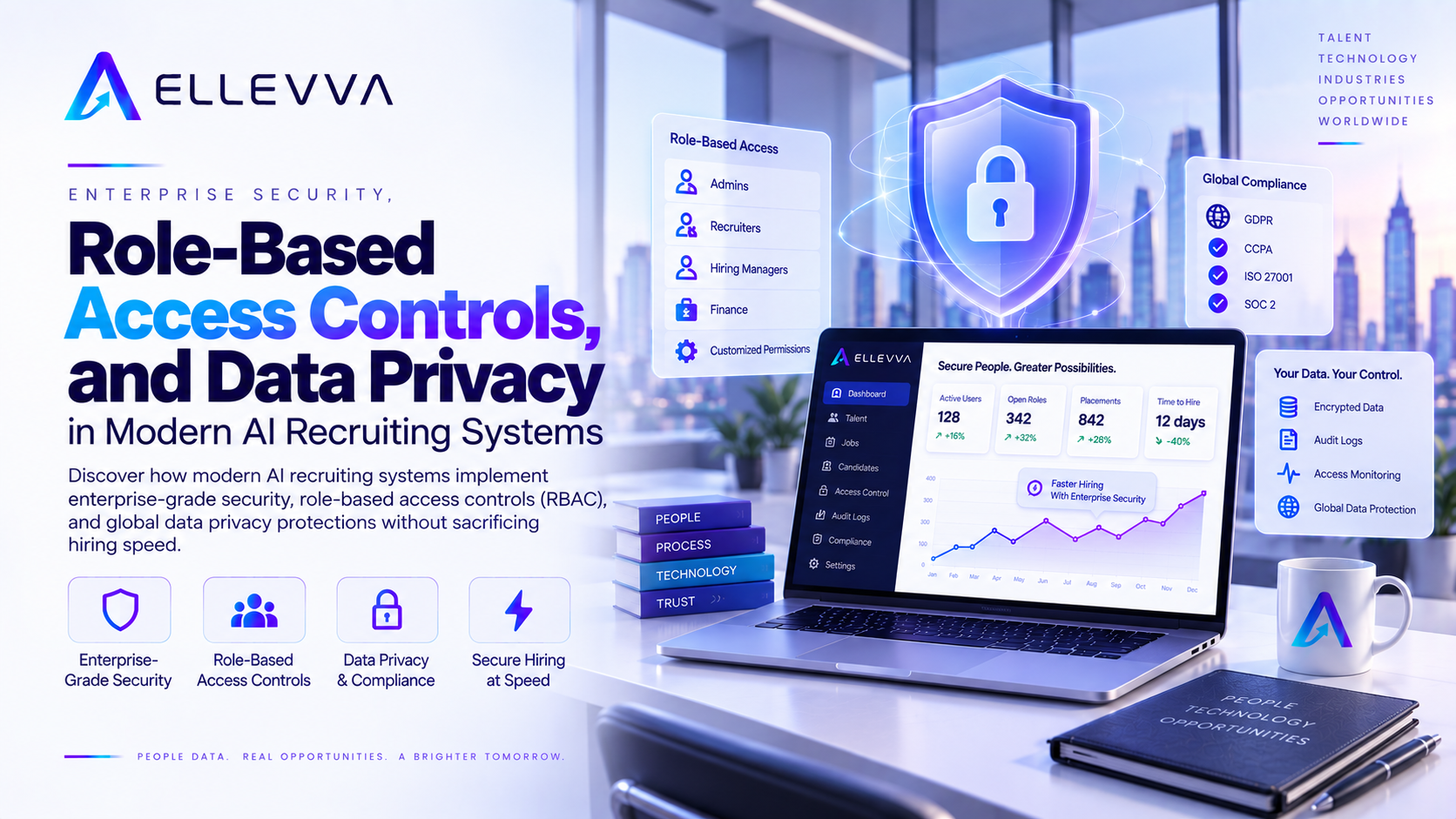
Modern enterprise hiring has fundamentally transformed. As recruitment operations shift away from fragmented spreadsheets toward unified AI-driven operating systems, the volume and sensitivity of processed data have surged. Sourcing engines, applicant tracking platforms, and talent matching algorithms now intake thousands of personally identifiable data points daily: resumes, national identity numbers, compensation records, background checks, medical credentials, and proprietary code evaluations.
For high-growth recruitment firms and global talent acquisition departments, operational efficiency and data protection can no longer exist in opposition. Modern talent operations leaders are challenged to discover how to reduce time to hire without compromising compliance, security posture, or candidate trust. Whether managing an agile software staffing agency or coordinating complex healthcare placements, enterprise-grade architecture—anchored by granular role-based access controls (RBAC), end-to-end data encryption, and transparent AI governance—is now mandatory.
The High-Stakes Data Landscape of Modern Recruitment
Recruitment workflows intersect with some of the most strictly regulated data domains in global business. Every phase of the hiring lifecycle creates, ingests, or transforms candidate and operational information:
- Candidate Identification and Application Data: Resumes, residential addresses, contact details, social profiles, and demographic records.
- Assessment and Evaluation Artifacts: Automated code evaluation telemetry, asynchronous video interviews, cognitive testing scores, and structured interview rubrics.
- Financial and Operational Records: Compensation expectations, billing rates, banking data managed by staffing agency accounting software, and timesheet data processed through staffing agency payroll software.
- Credentialing and Medical Compliance: State licenses, clinical certifications, and immunization records processed inside medical staffing agency software and healthcare staffing agency software.
Without unified security boundaries, data spreads rapidly across disconnected tools. Recruiters copy candidate contact info into unvetted note-taking apps; hiring managers export candidate evaluations onto unsecured laptops; and finance teams circulate unencrypted compensation spreadsheets. This sprawl creates critical vulnerabilities, exposing organizations to regulatory sanctions under GDPR, CCPA/CPRA, and industry-specific frameworks like HIPAA and SOC 2 Type II.
Architectural Pillars: Securing Modern AI Recruiting Platforms
To safely compress candidate cycles and systematically reduce time to hire, organizations need unified recruitment architectures built on foundational security standards.
+-----------------------------------------------------------------------+
|                   Unified AI Recruiting Command Center                |
+-----------------------------------------------------------------------+
        |                                   |                    |
        v                                   v                    v
+----------------------+         +--------------------+  +--------------+
| Granular RBAC & IAM  |         | AI Governance &    |  | End-to-End   |
| - Custom Role Scopes |         | Privacy Guardrails |  | Encryption   |
| - Field-Level Redact |         | - Ephemeral LLMs   |  | - TLS 1.3    |
| - Audit Logging      |         | - De-identification|  | - AES-256-GCM|
+----------------------+         +--------------------+  +--------------+
        |                                   |                    |
        +-----------------+-----------------+--------------------+
                          |
                          v
+-----------------------------------------------------------------------+
|    Cross-System Integrations (Payroll, Sourcing, ATS, Analytics)       |
+-----------------------------------------------------------------------+
1. Data Encryption at Rest and in Transit
Every sensitive asset must be protected with modern cryptographic primitives. Data in transit should mandate TLS 1.3 with strict forward secrecy, while all candidate records, database volumes, and object stores require AES-256 encryption at rest with automated key rotation managed via dedicated Key Management Services (KMS).
2. Multi-Tenant Isolation and Data Partitioning
Enterprise AI recruiting platforms operating in SaaS environments must ensure strict logical or physical separation across customer tenants. Logical multi-tenancy requires tenant-aware query layers and row-level security (RLS) enforcement at the database level to ensure that queries from one organization can never access another firm's candidate pools or proprietary matching configurations.
3. Ephemeral AI Inference and Model Isolation
A primary concern for enterprise security leaders is whether third-party LLMs or machine learning models train on proprietary data. Modern AI recruiting platforms must enforce zero-data-retention agreements with foundational model providers. Candidate resumes, internal interview transcripts, and performance evaluations must be processed ephemerally for matching, extraction, and scoring—never persisting in training weights.
Granular Role-Based Access Controls (RBAC)
Role-Based Access Control is the cornerstone of administrative security in recruitment software. In a dynamic talent acquisition ecosystem, different stakeholders require vastly different permissions.
Designing Principle of Least Privilege (PoLP) Workflows
Under the Principle of Least Privilege, users are granted only the access necessary to perform their immediate operational roles:
- Technical Recruiters: Full access to candidate resumes, technical skill profiles, and communication histories; restricted from viewing billing margins, rate cards, and background verification records.
- Hiring Managers: Access restricted to active candidates within their open requisitions, interview feedback submitted by peers, and structured evaluation scorecards; blinded from candidate address data, current compensation details, and other requisitions.
- Interviewers: Ephemeral access to the candidate's sanitized technical background and role-specific scorecard for the duration of the interview window.
- Finance and Payroll Administrators: Exclusive visibility into billing structures, bank routing numbers, and invoice histories within the accounting and payroll interfaces; zero access to private interview notes or sensitive medical credentials.
- Compliance & Privacy Officers: Read-only oversight across enterprise audit logs, consent tracking tables, and data retention deletion queues.
Field-Level Security and Dynamic PII Masking
Advanced platforms go beyond screen-level access by implementing field-level security. When an interviewer reviews an engineering applicant from a specialized staffing agency for software engineers, dynamic masking can hide the candidate’s name, graduation year, gender indicators, and location to simultaneously prevent cognitive bias and protect candidate PII. The full profile is unmasked only when an offer is initiated by authorized personnel.
Industry-Specific Security and Operational Requirements

Different recruitment verticals introduce distinct security, operational, and scheduling challenges. Modern platforms must seamlessly handle these specialized requirements.
| Industry Vertical | Primary Regulatory Frameworks | Sensitive Data Types | Core Platform Capabilities Required |
|---|---|---|---|
| Software & Technology | SOC 2, ISO 27001, CCPA | Code assessments, proprietary interview notes, remote work IP agreements | Technical talent matching, blind code screening, global sourcing compliance |
| Healthcare & Clinical Staffing | HIPAA, HITECH, Joint Commission | Clinical licenses, immunization records, drug screening results | Credential verification, clinical shift management, encrypted document vaults |
| Temporary & Light Industrial | FLSA, OSHA, State Labor Laws | Shift attendance, hourly wage logs, worker compensation claims | Automated shift dispatch, real-time payroll reconciliation, biometric integration |
Technical and Engineering Recruitment
When operating as a specialized talent partner for software engineers, protecting intellectual property is paramount. Technical screening often involves proprietary repositories, architectural take-home assignments, and private algorithmic challenges. AI recruiting systems must safeguard code submissions with sandboxed execution environments, preventing malicious code injection while ensuring applicant submissions remain confidential.
Healthcare and Medical Placement
In the clinical sector, deploying dedicated medical staffing agency software requires rigorous compliance with healthcare privacy laws. Clinical credentials, board certifications, vaccination histories, and malpractice insurance files must be stored in encrypted repositories with tamper-evident access logs. When automated workflows manage critical clinical rotations, scheduling systems must verify that credentials remain active and verified before shifts are dispatched.
Temporary and High-Volume Staffing
For contingent labor networks, temporary staffing agency software must synchronize candidate availability, location-based dispatching, and rapid onboarding. Modern staffing agency scheduling software ensures that shift allocations, overtime compliance, and multi-facility placements are managed transparently without exposing private contact details across public job boards or unprotected mobile channels.
Operationalizing Compliance: Auditing, Governance, and Analytics
Security and compliance are continuous operational practices rather than static checkboxes. To maintain trust across enterprise clients, recruitment leaders rely on real-time telemetry and structured governance.
Immutable Audit Trails
Every single action inside the hiring operating system must generate an immutable log entry. When a recruiter accesses a candidate record, an AI system updates a match score, or an administrator changes an access privilege, the event is recorded with cryptographic timestamps, user identity, IP address, and changed attributes. These logs provide crucial evidence during SOC 2, ISO 27001, and client procurement audits.
AI Bias Mitigation and Algorithmic Auditing
Data privacy also encompasses fair treatment. Modern regulations, such as New York City's Local Law 144, require automated employment decision tools (AEDT) to undergo independent bias audits. Enterprise AI matching engines must evaluate candidates based purely on demonstrable skills, experience vectors, and verified project outcomes, rather than proxy variables linked to protected demographic classes.
By tracking actionable recruitment operations metrics, talent organizations can monitor pipeline velocity alongside conversion rates, ensuring that AI-driven recommendations remain equitable, defensible, and transparent.
Enterprise Workforce Solutions and Global Sourcing Privacy

When scaling sourcing across international borders via multi-region talent pipelines, global sourcing platforms must balance candidate outreach with localized data transfer mandates. Modern enterprise workforce solutions—encompassing EWS global talent sourcing initiatives and distributed Employer of Record (EOR) hiring models—must honor region-specific cookie policies, offer single-click opt-out mechanisms, and store candidate profiles in regional cloud clusters that comply with cross-border transfer frameworks like the EU-US Data Privacy Framework.
Evaluating Enterprise Platforms: Beyond Free and Entry-Level Tools
Emerging staffing agencies frequently start with free or open-source solutions. While evaluating free staffing agency software or searching for the best free staffing agency software can be a sensible first step for solo recruiters testing basic workflows, entry-level tools often lack the foundational security frameworks required as candidate volumes grow.
The Hidden Costs of Entry-Level Recruitment Tools
As transaction volumes expand, disconnected point solutions introduce major compliance vulnerabilities:
Free / Open-Source ATS                    Enterprise AI Talent Operating System
-----------------------------------       ----------------------------------------
* Shared database tables                  * Dedicated tenant isolation & RLS
* Static, all-or-nothing admin roles      * Fine-grained, custom RBAC permissions
* Manual candidate data exports            * Automated, API-driven payroll & accounting sync
* No certified SOC 2 / HIPAA compliance   * Continuous compliance auditing & encryption
* Unmonitored data retention sprawl * Automated GDPR/CCPA data lifecycle queues- Siloed Back-Office Tools: Juggling standalone temp staffing agency software alongside disconnected bookkeeping tools creates manual data duplication risks. Modern teams favor consolidated platforms that connect front-office recruiting with back-office accounting and scheduling.
- Data Exfiltration Vulnerabilities: Without custom permission tiers, any team member can export candidate databases, exposing proprietary contact information.
- Compliance Gaps: Entry-level tools rarely support automated Right-to-be-Forgotten workflows or configurable data retention schedules, leaving firms exposed to statutory penalties.
Investing in dedicated AI-powered recruiting solutions allows scaling agencies and enterprise hiring teams to unify candidate discovery, interview pipelines, and back-office operations in one governed workspace.
Accelerating Velocity: Balancing Speed, Privacy, and Intelligence
Many organizations assume that implementing strict data access controls and enterprise privacy safeguards inherently slows down hiring. In reality, a well-architected AI recruitment system removes operational friction.
By leveraging embedded hiring analytics software, teams gain complete visibility into pipeline bottlenecks, candidate response latencies, and recruiter productivity metrics. Automated workflows instantly route verified profiles to appropriate hiring managers, pre-populate compliance verifications, and trigger interview scorecards—safely eliminating days of administrative delay.
When security controls, role-based permissions, and algorithmic intelligence are natively integrated into a unified operating system, talent teams no longer have to choose between velocity and governance. They achieve faster closures, maintain absolute compliance, and build lasting candidate trust.
Secure Your Enterprise Recruitment Operations with Ellevva
Ellevva brings intelligent AI matching, role-based pipeline visibility, automated operations, and robust enterprise security into a single platform. Whether you are scaling an executive search team, coordinating a high-volume staffing agency, or running an enterprise talent department, Ellevva ensures your candidate data remains protected at every stage.
Ready to transform your hiring workflows? Discover our platform capabilities or explore Ellevva's enterprise pricing and security tiers to get started today.