
Recruitment Operations
14 min readHow Enterprise Recruiting Teams Achieve 40% Lower Cost per Hire via Tech Consolidation and Sourcing Automation
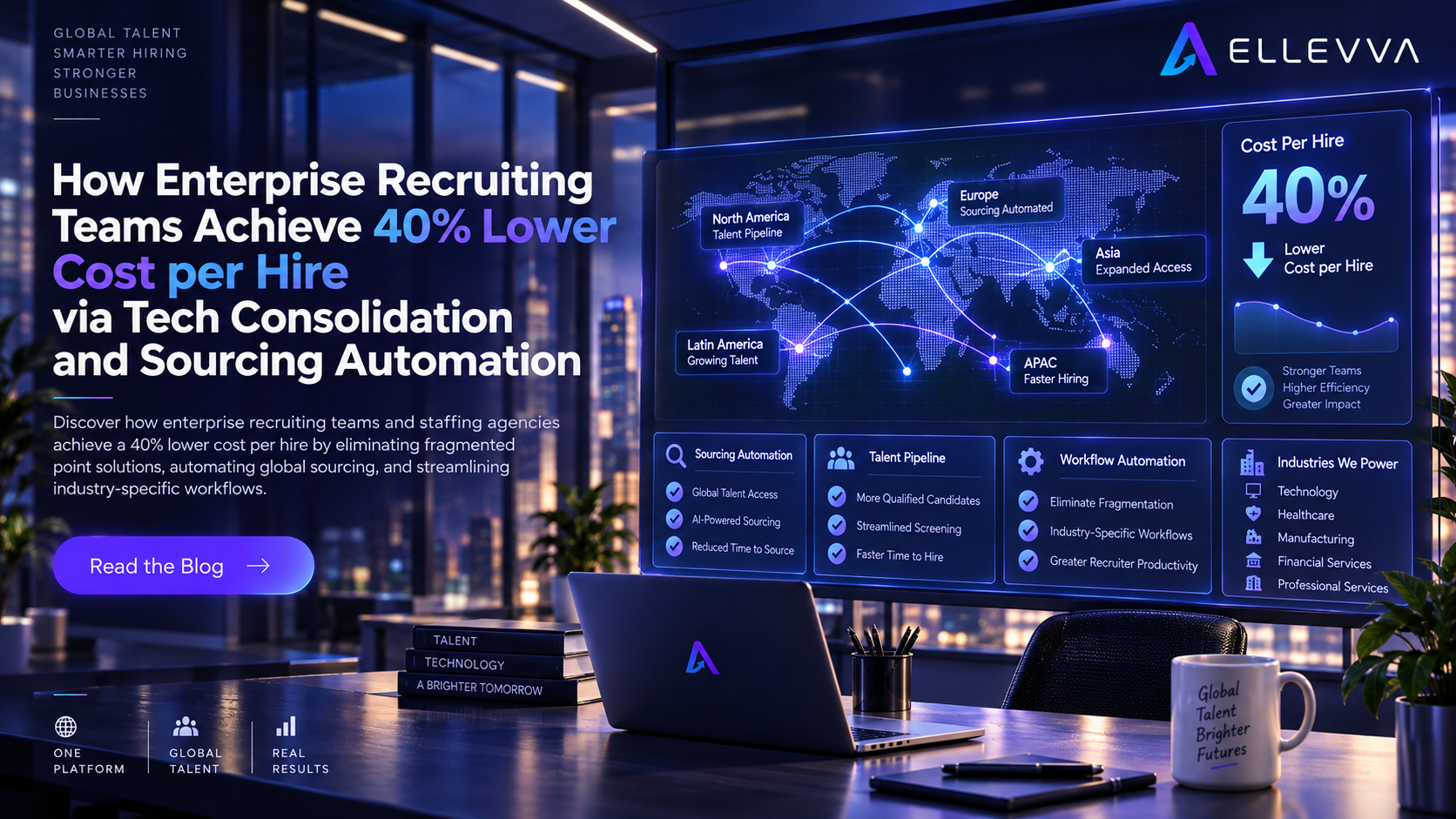
Discover how enterprise recruiting teams and staffing agencies achieve a 40% lower cost per hire by eliminating fragmented point solutions, automating global sourcing, and streamlining industry-specific workflows.
· VP of RevOps, Ellevva ·
In today’s volatile macroeconomic landscape, talent acquisition leaders face a dual mandate: hire top-tier talent faster while dramatically lowering operational expenditures. For high-volume enterprises and talent agencies alike, the traditional playbook—adding more recruiters, buying standalone point solutions, and paying hefty external agency fees—is no longer sustainable.
Recent operational benchmarks show that forward-thinking organizations are cutting their cost per hire by as much as 40% and shortening recruitment cycles by 60%. They are not achieving these results by working longer hours; they are doing it by systematically eliminating software bloat, consolidating disparate hiring platforms into unified systems, and deploying intelligent sourcing automation across global talent pools.

The True Cost of a Fragmented Talent Acquisition Stack
Over the past decade, the rapid expansion of the staffing agency software market led recruitment leaders to patch together disparate point tools. A typical enterprise recruiting operation often juggles:
- A legacy Applicant Tracking System (ATS) that acts purely as a static database.
- A standalone outbound sourcing tool or browser extension.
- Third-party candidate screening and assessment platforms.
- Independent interview scheduling tools.
- Disconnected staffing agency billing software and timesheet management systems.
- Fragmented HRMS databases for onboarding and candidate records.
The Hidden "Tool Tax"
This fragmentation creates operational friction known as the tool tax. When recruiters spend hours each day copying candidate profiles between platforms, manually entering invoice data, and reconciling mismatched candidate records, productivity plummets. Critical talent signals are lost, and candidates sit in unreviewed pipeline stages for days.
When calculating true cost per hire, organizations often account only for advertising spend and agency placement fees. However, the direct operational cost of software licensing redundancy, combined with lost recruiter hours and higher candidate drop-off rates, inflates total recruitment expenditure by thousands of dollars per placement.
Factors That Can Reduce Time to Hire and Drive Down Placement Costs
Understanding how to reduce the time to hire is directly correlated with lowering hiring expenses. Vacant roles produce indirect revenue loss, while prolonged evaluation cycles lead to lost candidates and inflated sourcing costs.
When examining the primary factors that can reduce time to hire, high-performing teams consistently focus on three levers:
+------------------------------------------------------------------------+
|                    PILLARS OF HIRING VELOCITY & ROI                    |
+------------------------------------+-----------------------------------+
| 1. Sourcing Velocity               | Automated matching from verified  |
|                                    | global talent networks            |
+------------------------------------+-----------------------------------+
| 2. Frictionless Progression        | Automated screening, unified      |
|                                    | interview pipelines & scoring     |
+------------------------------------+-----------------------------------+
| 3. Operational Integration         | Native ATS, HRMS, and integrated  |
|                                    | back-office billing workflows     |
+------------------------------------+-----------------------------------+- Automated First-Touch shortlisting: By using AI candidate matching to accelerate hiring velocity, talent teams instantly score verified candidate profiles against job requirements rather than manually reviewing hundreds of unqualified resumes.
- Unified Data Architecture: Bringing ATS workflows, customer/hiring manager relationship records, and operational pipelines into a single workspace eliminates context switching and duplicate entry.
- Continuous Engagement Loops: Automated candidate updates ensure active and passive candidates do not drop out midway through the recruitment funnel.
Automating Global Sourcing: Accessing Talent at Scale
One of the most effective strategies for slashing recruitment costs is modernizing top-of-funnel discovery. Enterprise teams that build resilient pipelines invest in sourcing global talent in software, product engineering, and business operations without paying premium retainers to localized boutique search agencies.
Sourcing High-Demand Technical Roles
Whether an enterprise is hiring a specialized staffing agency software engineer, a systems architect, or a full-stack developer, traditional manual Boolean searches on social networks yield diminishing returns. Modern platforms allow talent teams to tap into pre-vetted global networks encompassing over 50,000 verified profiles across North America, Europe, Asia, Latin America, and beyond.
By leveraging automated skill-verification algorithms, recruiting teams match complex technical criteria—spanning 120+ programming languages and frameworks—within seconds. This capability reduces external agency dependency, enabling in-house teams to maintain lean headcounts while filling high-complexity technical roles in under 18 days.
Industry-Specific Software Solutions: Tailoring Automation to Niche Demands
Cost-per-hire economics vary dramatically across sectors. A generic ATS often fails when deployed in specialized recruitment environments, forcing agencies and enterprises into expensive custom staffing agency software development projects or requiring additional third-party add-ons. Comprehensive enterprise AI recruitment solutions provide pre-built, domain-specific modules that streamline operations out of the box.
1. Healthcare and Clinical Recruitment
In medical environments, compliance, credentialing, and shift coordination are critical bottlenecks. Traditional tools struggle with the complex logistics of per-diem and travel staffing.
- Nurse staffing agency software and specialized nursing staffing agency software automate license verification, clinical certification tracking, and background checks.
- Integrating healthcare staffing agency scheduling software ensures that shift allocations, compliance expirations, and hospital placement requirements are synced directly with recruiter pipelines, minimizing open-shift overhead.
- Platforms built around the needs of care providers—similar to the comprehensive model popularized by SaaS staffing agency software CarePro-style architectures—allow care agencies to manage care plans, compliance, and billing without disjointed add-ons.
2. Dental Practice Staffing
Dental practices and regional Dental Service Organizations (DSOs) frequently experience sudden temporary staffing shortages for hygienists, assistants, and associate dentists. Purpose-built dental staffing agency software simplifies short-notice credential verification, hourly rate negotiations, and instant dispatching, cutting administrative placement overhead significantly.
3. Event and High-Volume Contingent Staffing
Managing hundreds of gig workers for sports venues, conferences, and exhibitions requires instant roster creation, automated SMS dispatch, and geo-fenced attendance tracking. Modern event staffing agency software consolidates recruitment with real-time shift check-ins and payroll export, eliminating manual data handling errors.

The Financial Impact of Tech Consolidation: From ATS to Back-Office Billing
Consolidating the recruitment tech stack directly impacts both operational expenditure (OpEx) and gross margin. Consider how a mid-sized staffing agency or enterprise recruiting team operates under a fragmented setup versus a consolidated operating system:
| Operating Metric | Disconnected Multi-Tool Stack | Consolidated AI Operating System | Operational Benefit |
|---|---|---|---|
| Average Time to Hire | 42 – 55 Days | 16 – 20 Days | 60% reduction in open role vacancy costs |
| Software Subscriptions | 5–8 Disconnected SaaS tools ($$$) | 1 Unified All-in-One Platform ($) | Eliminates duplicate licensing & integration fees |
| Recruiter Placement Capacity | 3–4 Hires / Recruiter / Month | 8–10 Hires / Recruiter / Month | Over 2x boost in recruiter productivity |
| Candidate Submission to Closure | 10% – 12% | 24.7% | Higher conversion with AI candidate matching |
| Billing & Timesheet Errors | 6% – 8% Manual Discrepancies | Automated Sync via Integrated Billing | Accelerated cash flow & reduced administrative hours |
Unifying Recruitment with Billing and Operations
A major source of administrative drain in talent agencies is the divide between placement workflows and financial operations. Implementing a robust recruitment software for staffing agency environments that natively pairs talent pipelines with automated timesheets, client contract terms, and staffing agency billing software removes hours of manual reconciliation every pay cycle.
When invoicing is directly triggered upon verified placement milestones, agencies accelerate their accounts receivable cycles and minimize billing disputes, driving direct bottom-line profitability.
5-Step Blueprint: Achieving a 40% Lower Cost per Hire
For enterprise hiring leaders ready to modernize their recruitment architecture, following a structured transition framework ensures immediate ROI without disrupting active hiring pipelines.
  +-------------------------------------------------------------------------+
  |                5-STEP RECRUITMENT MODERNIZATION BLUEPRINT               |
  +-------------------------------------------------------------------------+
  |                                                                         |
  |  [1. Stack Audit]  --->  Identify redundant point tools & data silos    |
  |          |                                                              |
  |          v                                                              |
  |  [2. Unify ATS/HRMS] ->  Consolidate candidate records & pipeline views |
  |          |                                                              |
  |          v                                                              |
  |  [3. Sourcing Auto] -->  Deploy AI matching on verified global talent   |
  |          |                                                              |
  |          v                                                              |
  |  [4. Back-Office]  --->  Integrate scheduling, compliance & billing     |
  |          |                                                              |
  |          v                                                              |
  |  [5. Metric Review] -->  Monitor submission-to-closure & recruiter ROI  |
  |                                                                         |
  +-------------------------------------------------------------------------+
Step 1: Conduct a Comprehensive Tech Stack and Waste Audit
Catalog every tool currently used by your sourcing, recruiting, and operations teams. Calculate the cost per user across each platform, factoring in maintenance, API connectors, and lost administrative time. Identify overlapping features (e.g., three separate tools with candidate emailing or resume parsing capabilities).
Step 2: Transition to an All-in-One Workforce Operating System
Replace standalone ATS, CRM, and communication tools with a single, intelligent operating system. Ensure the solution offers enterprise-grade security, role-based access control, and seamless pipeline transparency so hiring managers, recruiters, and executives collaborate in real time.
Step 3: Implement Automated Global Sourcing
Connect your open requirements to automated candidate discovery engines. Instead of relying solely on inbound job board applicants, use AI matching algorithms to instantly surface pre-verified profiles that match your specific skill, timezone, and compensation criteria.
Step 4: Streamline Niche Operational Workflows
Configure domain-specific automations tailored to your industry—whether that involves automated credential verification for travel nurses, instant shift scheduling for hospitality, or skill assessments for full-stack software engineers.
Step 5: Track Hiring Operations Metrics in Real Time
Establish a central operations command center to monitor live performance indicators:
- Submission-to-interview ratio
- Interview-to-offer rate
- Offer acceptance rate (targeting >90%)
- Average days to hire
- Total cost per hire across departments
Frequently Asked Questions
The most common questions enterprise teams and staffing agencies ask when consolidating recruitment technology and automating sourcing.
How does consolidating recruitment software reduce cost per hire so quickly?
Consolidating tools lowers costs in two ways: first, it eliminates multiple overlapping software subscriptions, integration maintenance costs, and administrative overhead. Second, it automates manual tasks like candidate searching, resume screening, and scheduling, allowing recruiters to manage twice the volume of open roles without adding headcount.
Can unified staffing agency software solutions handle both permanent and contingent staffing?
Yes. Modern workforce operating systems are built to support direct-hire corporate enterprise roles as well as high-volume contingent, contract, and travel staffing. By unifying candidate management with automated time tracking and billing modules, teams can oversee both business models within a single pane of glass.
How does AI candidate matching differ from basic keyword search?
Keyword search relies on exact text matches, which often overlooks qualified candidates who use different terminology or phrasing on their resumes. AI candidate matching evaluates contextual signals—including project experience, technology stacks, career progression, domain knowledge, and verified skill assessments—to deliver highly accurate match scores.
Build a Faster, Leaner Hiring Engine with Ellevva
High-performing recruiting teams no longer rely on disconnected spreadsheets and bloated software stacks. By bringing AI candidate matching, ATS workflows, HRMS operations, and real-time analytics into one intelligent command center, enterprise teams achieve an average 18-day time to hire, a 92% offer acceptance rate, and a 40% lower cost per hire.
Ready to transform your recruitment operations? Explore our flexible pricing plans for AI-powered hiring or connect with our team to see how Ellevva can accelerate your talent acquisition strategy.