
Workforce Operations
12 min readWhy Enterprises Choose an AI Workforce Operating System to Consolidate Hiring Tools
Discover why leading enterprises and staffing agencies are abandoning fragmented hiring tools and legacy applicant tracking systems in favor of an AI-powered workforce operating system. Learn how a unified HR workspace leverages intelligent matching and automation to reduce time to hire and streamline global recruitment.
By Dana Ostrowski · VP of RevOps, Ellevva ·
The Growing Need for Consolidation in Enterprise Hiring
Modern talent acquisition is complex, often relying on a fragmented web of point solutions. From sourcing extensions and screening apps to interview schedulers and onboarding portals, the average recruitment team toggles through dozens of applications just to move a single candidate from discovery to closure. This fractured ecosystem is the primary reason why leading enterprises and top-tier agencies are pivoting. They are recognizing that disconnected tools create data silos, slow down recruiters, and severely degrade the candidate experience. Enter the modern workforce operating system. By consolidating scattered processes into a single source of truth, these comprehensive systems eliminate the operational friction that plagues talent acquisition. In today's hyper-competitive market, relying on disjointed software stacks is no longer a viable strategy. Instead, enterprises are adopting an ai powered recruiting platform to bring everything ΓÇö from automated sourcing and smart matching to ATS workflows and analytics ΓÇö under one digital roof. This guide explores the structural shift from isolated tools to a holistic environment, examining why organizations of all sizes are abandoning patchwork systems in favor of an integrated approach. We will dive into the specific features that make an ai recruiting platform so transformative, the operational metrics it impacts, and how consolidating your tech stack can fundamentally change your hiring velocity.
The Cost of Disconnected Hiring Tools
When a company's hiring infrastructure relies on loosely integrated software, the cracks show up quickly. A recruiter might source candidates in one platform, manually import their profiles into an enterprise ATS, and then track their interview progress in an entirely separate spreadsheet or HR module. This lack of integration leads to lost candidate profiles, dropped communications, and an inability to track the true cost per hire. For staffing firms, this problem is magnified. A firm managing multiple client requirements needs robust software for staffing agency operations to keep track of submissions, closure rates, and client feedback. If their tools are disjointed, recruiters spend more time doing administrative data entry than actually building relationships with candidates. Furthermore, a fractured toolset provides no real-time visibility for leadership. When data lives in silos, reporting becomes a tedious monthly exercise rather than a live operational dashboard. Hiring delays cost businesses substantial growth. If your recruiters are bogged down by administrative overhead, they are missing out on securing top talent. Consolidating your hiring tools into a single ecosystem doesn't just clean up your software bill; it fundamentally changes the speed and efficiency with which your team can execute.
What Is a Workforce Operating System?
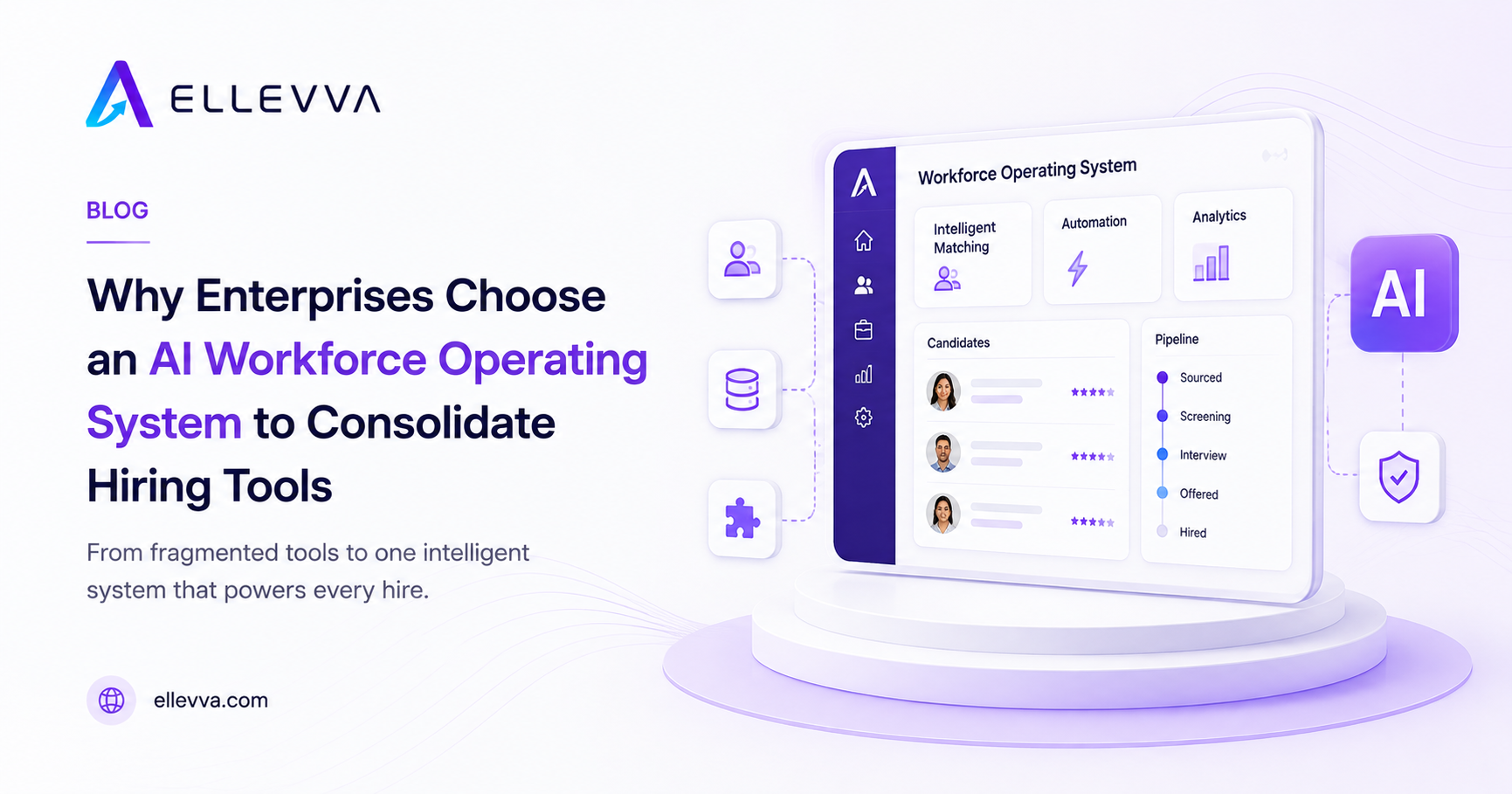
A workforce operating system is more than just an applicant tracking system. It is a comprehensive digital environment that manages the entire lifecycle of hiring, from initial demand generation and talent sourcing to interviewing, onboarding, and beyond. Think of it as the central nervous system for your hiring operations. Unlike a legacy enterprise ATS that merely acts as a digital filing cabinet for resumes, a modern OS actively drives the hiring process forward. It incorporates AI matching, automated follow-ups, and live analytics. By bringing together the ATS, HRMS (Human Resource Management System), and operations dashboard, it creates a true unified HR workspace. In this unified environment, hiring managers, recruiters, and HR executives collaborate seamlessly. When a new requirement is posted, the system immediately leverages AI to score the best fit from a pool of verified profiles. Interview pipelines are tracked transparently, and successful closures are documented with automated reporting. Every action is logged, visible, and actionable, meaning decisions are made based on real-time insights rather than outdated spreadsheets.
The Evolution to a Unified HR Workspace
For years, the standard approach to HR technology was to buy specialized tools for specialized problems. If you needed to hire contractors quickly, you might invest specifically in temp staffing agency software or temporary staffing agency software. If you were hiring for large-scale events, you'd look for event staffing agency software. While these niche solutions solved immediate tactical needs, they created long-term strategic headaches. When you have one platform for temporary workers, another for permanent enterprise roles, and yet another for event staff, data normalization becomes impossible. A candidate who might be perfect for a permanent role could be hidden in the database of the temp system, completely invisible to the enterprise recruiters. Today, the paradigm has shifted. A true unified HR workspace breaks down these artificial boundaries. Whether a team is recruiting full-time software engineers, filling temporary administrative roles, or staffing a massive weekend conference, the underlying mechanics of matching talent to opportunity remain similar. A sophisticated workforce operating system like Ellevva can handle multiple engagement types within a single platform, eliminating the need for highly fragmented, niche tools.
The Core Advantages of an AI Powered Recruiting Platform
The integration of artificial intelligence is what transforms a traditional database into an active, intelligent hiring partner. An ai powered recruiting platform doesn't just store data; it interprets signals. Intelligent Matching: when a hiring requirement is established, the platform's AI algorithms analyze the required skills, experience levels, and availability against thousands of verified candidate profiles, surfacing the most relevant talent instantly and scoring candidates based on fit, so recruiters start their day with a curated shortlist instead of running complex Boolean searches. Workflow Automation: routine tasks are the enemy of recruiter productivity, and an ai recruiting platform automates repetitive steps like drafting emails, updating the database, and notifying hiring managers, with triggers that send assessments, schedule interviews, and update candidate statuses automatically. Real-Time Visibility: with a consolidated system, leadership gains a hiring command center that shows live metrics such as total hires, offer acceptance rates, and top departments, allowing organizations to proactively address bottlenecks rather than reacting to them weeks later.
Why Agencies Are Rethinking Software for Staffing Agency Needs
Staffing agencies face a unique set of challenges. They are essentially operating a high-volume sales and delivery engine where the product is human talent. To thrive, they need technology that can keep up with rapid client demands while maintaining a high quality of service. Historically, agencies might have cobbled together a tech stack from various providers, perhaps trying a free staffing agency software for initial candidate tracking, before realizing it lacked the horsepower for serious volume. The search for the best free staffing agency software often leads to platforms that offer basic functionality but aggressively gate essential features like advanced reporting, API access, or automated AI matching. In the mid-market, some agencies turned to solutions like saas staffing agency software carepro or similar vertical-specific SaaS products, which represented a step up from spreadsheets and freemium models but often struggled to integrate deeply with broader enterprise HR systems. As staffing firms scale, their needs become highly specific, requiring custom workflows, localized compliance tracking, and proprietary matching algorithms ΓÇö driving growing investment in staffing agency software development. By employing a dedicated staffing agency software engineer or partnering with a platform that offers deep API integration and custom development capabilities, large staffing firms can build proprietary extensions on top of a core workforce operating system, combining the robust infrastructure and AI capabilities of an enterprise platform with the bespoke workflows required by their specific agency model.
The Tangible Impact: How Consolidation Helps Reduce Time to Hire
The ultimate metric of success in recruitment is time to hire. Extended hiring cycles lead to lost productivity, increased reliance on costly contractors, and a higher likelihood that top candidates will accept offers from faster-moving competitors. Consolidating your tools into an ai recruiting platform is one of the most effective ways to reduce time to hire. Instant sourcing lets recruiters tap into a built-in global talent network of pre-vetted candidates rather than starting every search from scratch. Automated screening evaluates candidates against role requirements immediately, surfacing the top applicants so recruiters focus where it matters. Seamless collaboration in a unified HR workspace drastically shortens feedback loops, letting a hiring manager review an AI-scored profile, leave a comment, and approve an interview in a single click. Reduced administrative burden, through automated scheduling and follow-ups, keeps candidates moving through the pipeline continuously and eliminates the black-hole delays that cause candidates to drop out. By streamlining the process from the initial requirement post to the final successful closure, enterprises often see a drastically faster time to hire when moving from fragmented tools to a consolidated platform.
Replacing the Legacy Enterprise ATS
The traditional enterprise ATS was designed primarily for compliance and record-keeping. It was built for an era when the biggest challenge was legally storing thousands of paper resumes in a digital format. Today, the challenge is entirely different. Companies are overwhelmed with data but starved for insights. A modern workforce operating system replaces the passive repository model with an active engine. It doesn't just ask, who applied for this job? It asks, who in our entire ecosystem is the best fit for this role right now, and how do we engage them automatically? This shift is crucial for global enterprises managing complex hiring motions across multiple countries and departments. They need a system that offers enterprise-grade security, role-based access, and compliance workflows natively, without requiring third-party bolt-ons that compromise data integrity.
Scaling with Your Organization
Whether you are a hyper-growth tech startup, a global manufacturing enterprise, or a high-volume staffing agency, the software you use should scale with your ambition. For smaller teams, the temptation is always to start small ΓÇö perhaps experimenting with a free staffing agency software or a lightweight ATS. But as the organization grows, the hidden costs of these free or cheap systems become apparent: data migration, recruiter retraining, and lost productivity far outweigh the initial savings. Investing early in a flexible ai powered recruiting platform ensures that you have the foundational architecture in place to handle future growth. As your hiring volume increases, you don't need to rip and replace your software; you simply unlock new tiers of automation and intelligence. The platform grows seamlessly from managing a few dozen requirements a year to handling thousands of submissions, interviews, and closures a month.
The Specific Use Cases of Consolidated Software
High-volume event staffing: coordinating hundreds of workers for a weekend festival or conference used to require dedicated event staffing agency software, systems that excelled at bulk messaging and shift scheduling but failed at long-term candidate relationship management. A unified workforce operating system handles the burst-capacity needs of event staffing through automated AI matching and mass communications, while still retaining those worker profiles in the central database for future, potentially permanent, enterprise roles. Temporary and contract work: managing contractors requires precise tracking of availability, compliance, and billing ΓÇö traditionally the domain of temp staffing agency software or temporary staffing agency software. A holistic platform integrates these operational metrics directly into the HRMS modules, ensuring that whether a worker is on a 3-month contract or a permanent full-time agreement, their data, performance, and history are centralized. Bespoke agency workflows: for highly specialized executive search firms, standard out-of-the-box software often falls short, and this is where the intersection of a strong platform API and custom staffing agency software development comes into play ΓÇö a firm can hire a staffing agency software engineer to build custom assessment portals or bespoke client reporting dashboards that plug directly into the core ai recruiting platform, maintaining the unified data model while providing a uniquely branded experience for their high-end clients.
The Value of Data Centralization
Data is only valuable if it is accessible and actionable. In a fragmented tech stack, data is scattered. You might know your cost per hire from your finance software, your source of hire from your sourcing tool, and your time to fill from your ATS, but correlating those data points is a monumental task. In a unified HR workspace, every action generates a data point in a single, cohesive database. You can instantly see how AI matching scores correlate with long-term employee retention, or which sourcing channels consistently deliver candidates that pass technical screenings. This level of reporting allows talent acquisition leaders to shift from tactical execution to strategic advisory, backing up hiring-timeline commitments with hard, integrated data.
Why Relying on Free Is a False Economy
In the early stages of a business, budget constraints are real. The appeal of best free staffing agency software is undeniable. However, these tools are fundamentally designed to capture users, not to optimize complex enterprise hiring motions. When you use free staffing agency software, you are inevitably trading capability for cost. You sacrifice data security, API access, and the advanced AI features that actually drive ROI. More importantly, you sacrifice recruiter efficiency ΓÇö if a free tool saves a small monthly fee but costs your recruiter ten hours of manual data entry, the business is losing money. Transitioning from these basic tools or niche mid-market solutions like saas staffing agency software carepro to a comprehensive workforce operating system like Ellevva is an investment in human capital, an acknowledgment that your recruiting team's time is valuable and should be spent engaging with candidates, not wrestling with software.
Embrace the Future of AI Hiring
The talent landscape is evolving faster than ever. Candidate expectations for a smooth, transparent hiring process are at an all-time high. Businesses that force candidates to navigate clunky, disjointed systems are losing out to those that offer a seamless, modern experience. By consolidating your hiring tools into a single, intelligent platform, you align your entire organization around a common goal: finding and securing the best talent efficiently. You break down the walls between HR, recruiting, and hiring managers, empowering your team with AI that handles the heavy lifting of sourcing and matching so they can focus on the human elements of hiring. Whether you are looking to replace an aging enterprise ATS, upgrade your software for staffing agency operations, or simply find a way to consistently reduce time to hire, the answer lies in consolidation. The future belongs to those who view hiring not as a series of disconnected tasks, but as a continuous, intelligent operating system. Ready to transform your hiring operations? Discover how leading teams use Ellevva to bring AI matching, automated workflows, and powerful analytics into one unified workspace ΓÇö explore our solutions for enterprise and staffing teams at https://www.ellevva.com/solutions and view our flexible pricing plans at https://www.ellevva.com/pricing.