
The Modern Staffing Agency Tech Stack: How Next-Gen Software Accelerates Placements
Discover how modern staffing agency software—from AI-driven matching and shift scheduling to payroll, accounting, and hiring analytics—slashes time to hire across tech, healthcare, and temp recruitment.
By Ellevva ·
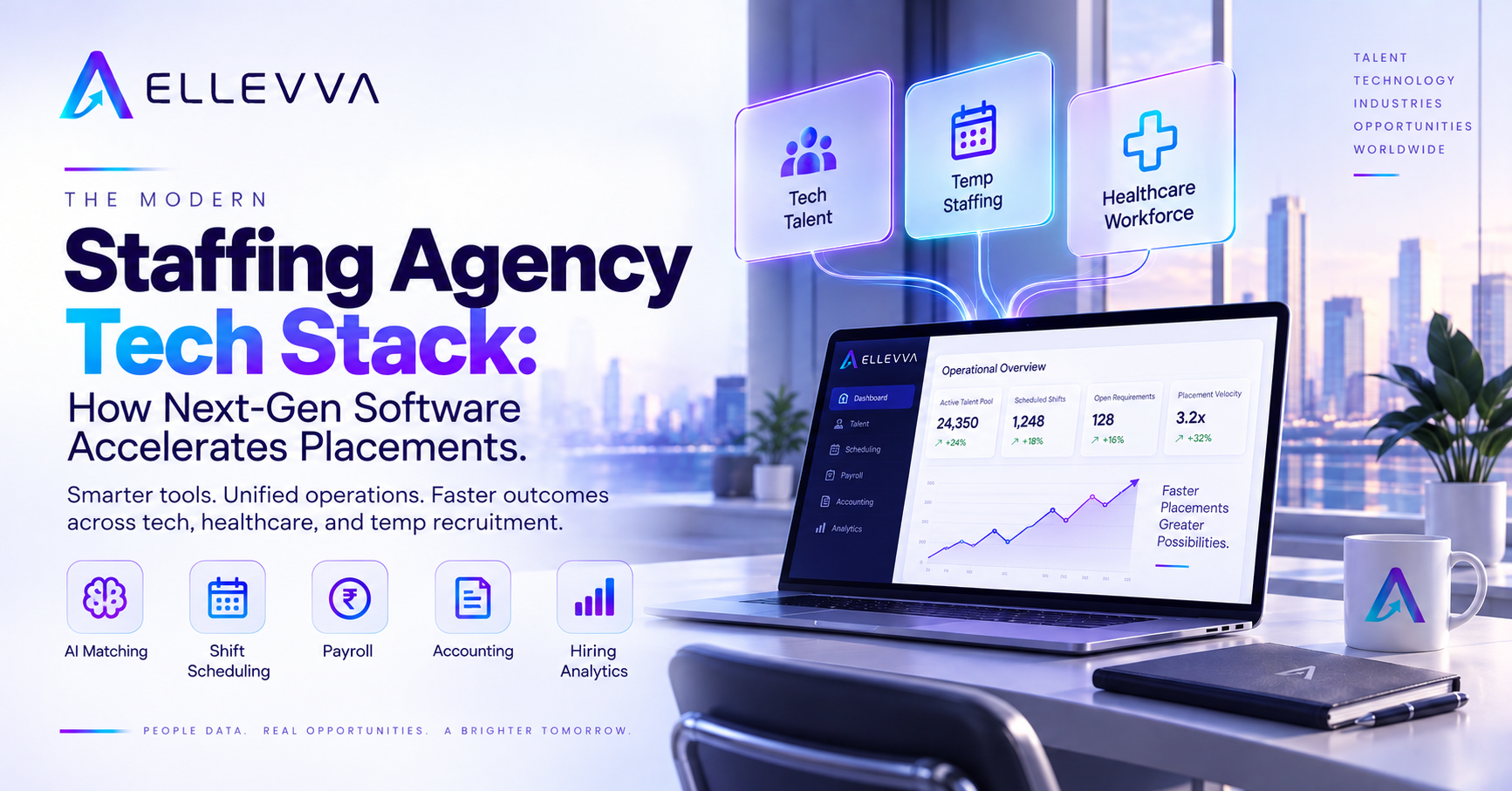
The Modern Staffing Agency Tech Stack: How Next-Gen Software Accelerates Placements
Recruitment agencies and staffing firms operate in an unforgiving environment. Client demands change in hours, candidate expectations are higher than ever, and legacy systems create friction at every turn. Whether managing high-volume shifts or sourcing highly specialized technical roles, the gap between top-performing recruitment firms and lagging agencies usually comes down to their operational infrastructure.
Building an agile recruitment engine requires more than a simple database of resumes. It demands a fully connected tech stack where sourcing, qualification, scheduling, back-office operations, and performance intelligence work in unison.
The Anatomy of Modern Staffing Agency Software
Historically, agency recruiters spent most of their working hours manually updating spreadsheets, re-entering candidate data across different tools, and chasing timesheet approvals. Today's modern platforms integrate the entire placement lifecycle into cohesive workflows.
A complete staffing ecosystem generally spans five core pillars:
- Applicant Tracking & Candidate Relationship Management (ATS/CRM): Centralizing talent pools, tracking pipeline stages, and automating communication touchpoints.
- Front-Office Scheduling & Dispatch: Matching available talent with fluctuating client shift demands in real time.
- Back-Office Payroll & Financials: Managing complex billing rates, gross margin tracking, tax compliance, and multi-state contractor disbursements.
- Talent Sourcing & AI Matching Engines: Evaluating verified technical competencies, availability signals, and cultural fit.
- Hiring Analytics & Operational Dashboards: Identifying pipeline bottlenecks, conversion drop-offs, and recruiter productivity metrics.
Connecting these modules eliminates data silos, helping agencies maintain speed and consistency throughout volatile market cycles.
How to Reduce Time to Hire Across the Placement Lifecycle
Time-to-fill and time-to-hire remain the definitive benchmarks of agency performance. When open requisitions sit unfilled, clients lose revenue and candidates accept competing offers. Understanding how to reduce time to hire requires identifying where friction accumulates across the pipeline.
1. Automated Candidate Sourcing and Pre-Screening
Manual resume screening is one of the most time-consuming phases of talent acquisition. By deploying automated parsing and AI-assisted qualification, recruiters can score inbound applicants instantly against job requirements. Rather than reviewing hundreds of unqualified submissions, recruiters can focus their attention on the top percentile of verified candidates, empowering firms to dramatically reduce time to hire on critical open requisitions.
2. Multi-Channel Outreach and Instant Engagement
Email-only outreach often leads to delayed response times. Modern recruitment solutions incorporate automated SMS, in-app notifications, and instant calendar integrations so candidates can schedule screening calls directly. Removing asynchronous back-and-forth communication shaves critical days off the initial stage of the hiring cycle.
3. Pipeline Visibility and SLA Tracking
When hiring managers fail to provide feedback within 48 hours of an interview, candidate momentum stalls. Unified dashboards track candidate velocity across every stage, alerting account managers when requisitions fall behind agreed Service Level Agreements (SLAs).
Exploring dedicated AI recruitment solutions for staffing teams enables agencies to replace fragmented spreadsheets with automated, high-velocity workflows.
Managing Temporary and Contingent Workforces
Temporary and contract staffing firms face distinct operational demands compared to direct-hire agencies. Contingent staffing requires high velocity, real-time availability tracking, and flawless shift management.
Deploying purpose-built temporary staffing agency software—often referred to in high-turnover sectors as temp staffing agency software—empowers firms to fill open slots instantly without losing track of compliance or payroll data.
Essential Features in Contingent & Temp Staffing Solutions
- Dynamic Roster Management: Maintaining active rosters of pre-screened talent ready for immediate dispatch.
- Automated Shift Broadcasts: Instantly notifying qualified workers of available shifts via mobile apps, allowing self-scheduling and instant confirmation.
- Geo-Fenced Time Tracking: Verifying on-site attendance via mobile check-ins to prevent time leakage and ensure accurate client billing.
- Compliance & Credential Tracking: Monitoring expiring certifications, licenses, background checks, and right-to-work documentation before shift assignment.
Robust staffing agency scheduling software ensures that last-minute cancellations or unexpected surges in demand can be resolved in minutes rather than hours, safeguarding client relationships and service delivery.
Unifying Back-Office Operations: Payroll and Accounting
For staffing agencies, cash flow management and compliance are just as critical as sourcing talent. Disconnected accounting workflows create billing disputes, delay payroll, and jeopardize contractor trust.
+-----------------------------------------------------------------------------------+
|                         Unified Staffing Architecture                             |
+-----------------------------------------------------------------------------------+
|  Front Office: AI Sourcing -> Fast Screening -> Shift Scheduling -> Placement     |
+-----------------------------------------------------------------------------------+
|                                        | (Real-Time Data Sync)                    |
|                                        v                                          |
+-----------------------------------------------------------------------------------+
|  Back Office: Digital Timesheets -> Margin Calculation -> Multi-State Payroll     |
|               -> Automated Invoicing -> Integrated Accounting (General Ledger)    |
+-----------------------------------------------------------------------------------+
Why Specialized Financial Software Matters
Generic accounting platforms rarely accommodate the complexities of contingent staffing. Dedicated staffing agency payroll software and specialized staffing agency accounting software address industry-specific requirements:
- Split Rates and Overtime Calculations: Managing varying pay and bill rates across different shifts, job classifications, and geographies.
- Client-Specific Invoicing: Consolidating multiple placements, branch offices, and purchase orders into formatted invoices that match client accounting rules.
- Direct Margin Visibility: Calculating gross margins per contractor and per account in real time, factoring in burden rates, workers' compensation, and taxes.
- Multi-Jurisdiction Compliance: Handling complex local, state, and national tax withholdings for remote or multi-location contractor deployments.
Integrating front-office placements directly with back-office accounting eliminates manual double-entry, minimizes payroll errors, and provides executive teams with clear cash-flow forecasting.
Specialized Staffing Workflows: Tech and Healthcare
While generalist staffing firms benefit from standardized workflows, specialized sectors require targeted platform capabilities.
1. Staffing Agency for Software Engineers & Tech Talent
Technical recruitment demands precision. Generic keyword searches frequently fail to distinguish between frontend frameworks, infrastructure stacks, or architectural seniority levels.
A specialized software staffing agency or dedicated staffing agency for software engineers relies on deep skill-graph matching, verified project histories, and automated technical evaluations. To satisfy client demand for specialized engineering talent, leading agencies also leverage enterprise and EWS global talent sourcing methodologies—tapping distributed international pools of pre-vetted engineers across multiple time zones.
To see how automated skill indexing accelerates candidate shortlisting, review this breakdown of AI matching and hiring velocity.
2. Healthcare and Medical Staffing
Healthcare recruitment carries zero margin for error. Operating as a medical staffing agency software environment requires strict adherence to regulatory standards, clinical compliance, and rapid credential verification.
Key requirements for healthcare staffing agency software include:
- Automated License Verification: Continuous integration with state medical boards and registry databases to confirm valid licensure.
- Shift-to-Credential Matching: Ensuring only personnel with required ICU, telemetry, or specialty certifications can view and accept designated shifts.
- Audit-Ready Documentation: Maintaining secure digital vaults for immunization records, background checks, and HIPAA compliance training.
Evaluating Software Options: Free vs. Enterprise Systems
Early-stage recruitment agencies and independent recruiters often look for free staffing agency software or entry-level tools to manage their initial requisitions. While free platforms can help solo operators organize basic candidate contacts, scaling firms quickly run into functional limits.
| Feature Capability | Free & Entry-Level Tools | Modern Enterprise Staffing OS |
|---|---|---|
| Candidate Database | Limited records (e.g., up to a few hundred) | Unlimited, searchable centralized database |
| Sourcing & Matching | Manual keyword tagging | Multi-parameter AI scoring & global network search |
| Scheduling & Dispatch | Basic calendar sync | Automated shift broadcast, geo-fencing, auto-fill |
| Back-Office Integration | Manual export to spreadsheets | Automated payroll, billing, & multi-state tax handling |
| Analytics & Reporting | Basic exportable metrics | Real-time dashboards, SLA alerts, margin tracking |
| Compliance & Security | Basic password security | Role-based permissions, SOC 2 compliance, audit logs |
While identifying the best free staffing agency software makes sense during the first few months of launching a boutique agency, growing firms transition to unified workforce operating systems as placement volume expands. The cost of manual operational delays and lost placements far outweighs the investment in professional automation.
Driving Growth with Hiring Analytics Software
High-performing staffing leaders make decisions grounded in operational data. Implementing purpose-built hiring analytics software transforms raw pipeline data into actionable strategic insights.
Core Metrics Every Staffing Firm Must Monitor
- Submission-to-Interview Ratio: Measures how accurately recruiters understand client specifications and qualify candidates before presentation.
- Interview-to-Offer Conversion: Reflects candidate quality, interview preparation, and alignment with client expectations.
- Time in Stage: Identifies specific pipeline phases where candidates experience delays, allowing operational adjustments.
- Recruiter and Account Manager Productivity: Evaluates outbound activity, qualification speed, and gross margin contribution per team member.
- Client Gross Margin Realization: Tracks billing rates against direct costs, highlighting which accounts drive real profitability.
With transparent dashboards, leadership teams can identify operational bottlenecks early and coach recruiters effectively.
Checklists for Upgrading Your Staffing Infrastructure
When evaluating a new platform or unifying an existing software stack, use this practical checklist to ensure your agency selects the right solution:
Core Functional Requirements
- [ ] Unified Interface: Does the platform bring ATS, CRM, scheduling, and analytics into one workspace without requiring complex middleware?
- [ ] Contextual AI Matching: Can the system accurately evaluate technical competencies, verified experience, and availability signals?
- [ ] Mobile-First Experience: Can temporary workers, contractors, and hiring managers review shifts, approve timesheets, and track interview stages via mobile?
- [ ] Scalable Data Architecture: Does the system support international talent sourcing, multi-entity billing, and high-volume applicant pipelines?
- [ ] Enterprise Security: Are role-based permissions, audit trails, and data privacy safeguards built directly into the core platform?
Accelerate Your Agency's Placement Velocity
In modern recruitment, operational speed and data clarity determine market share. By moving away from fragmented tools and adopting an integrated workforce platform, staffing firms can streamline sourcing, protect gross margins, and consistently deliver top-tier talent to clients.
Ready to modernize your recruitment operations and scale placement velocity? Explore Ellevva's flexible hiring plans to equip your team with intelligent sourcing, automated workflows, and unified pipeline control.
Related resources
Tags: software staffing agency, staffing agency for software engineers, reduce time to hire, how to reduce time to hire, hiring analytics software, staffing agency scheduling software