
The Modern Staffing Agency Software Guide: Accelerating Placements, Managing Operations, and Scaling Global Talent
Discover how modern staffing agency software, intelligent workforce operating systems, automated scheduling, back-office payroll, and global talent sourcing help agencies reduce time to hire and scale placements.
By Ellevva ·
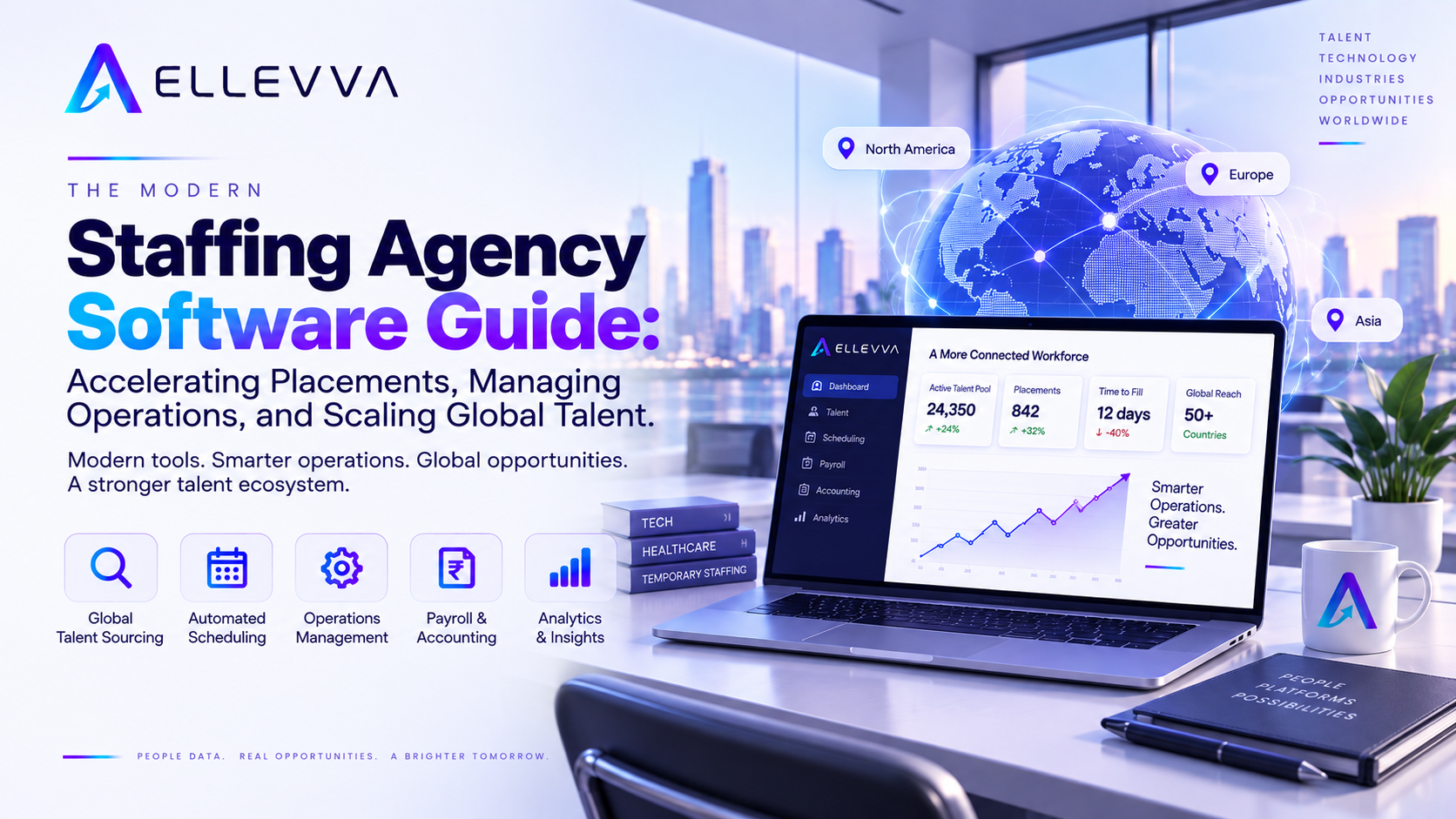
The Modern Staffing Agency Software Guide: Accelerating Placements, Managing Operations, and Scaling Global Talent
The recruitment and talent placement industry is undergoing its most radical transformation in decades. Whether managing high-volume temporary placements, niche technical recruiting, or complex healthcare shifts, traditional staffing firms face mounting friction: fragmented software tools, manual recruiter follow-ups, messy candidate records, and sluggish hiring cycles that frustrate both clients and job seekers.
To remain competitive, modern agencies are replacing point solutions with unified workforce operating systems. A purpose-built tech stack bridges front-office sourcing with back-office operations, allowing agencies to automate candidate matching, streamline multi-party interview scheduling, manage complex payroll compliance, and dramatically lower placement friction.
In this guide, we explore how cutting-edge staffing technology helps agencies optimize specialized workflows, leverage global sourcing channels, and systematically reduce time to hire.
The Core Capabilities of Modern Staffing Agency Software
A modern recruitment firm cannot operate efficiently when recruiters must switch between four different systems just to screen, schedule, place, and invoice a candidate. The most effective staffing agency software consolidates multiple essential operational modules into a single pane of glass:
- Intelligent ATS & Talent CRM: Centralizes verified talent profiles, tracks candidate activity, and automates communication touchpoints.
- Shift and Interview Scheduling: Handles multi-timezone client coordination, automated interview bookings, and complex shift rosters.
- Back-Office Accounting and Payroll: Automates contractor pay rates, client bill rates, gross margin calculations, timesheet approvals, and tax compliance.
- Workforce Analytics and Command Dashboards: Tracks submission-to-interview ratios, offer acceptance velocity, recruiter productivity, and pipeline bottlenecks in real time.
By uniting these functional areas within an end-to-end platform, agency leaders eliminate data silos, reduce operational overhead, and empower recruiters to focus on building high-value client relationships.
Scaling Contingent Labor with Temporary Staffing Agency Software
Contingent, contract, and interim placements operate at a very different cadence than executive search. Temporary staffing demands lightning-fast turnaround times, continuous compliance verification, and instant roster adjustments.
Overcoming the Unique Challenges of Temp Placements
Temp staffing agency software is engineered to resolve high-friction operational hurdles:
- Rapid Turnaround Roster Management: When a client requests 15 workers for an upcoming project, recruiters cannot afford days of manual outreach. Automated talent pooling matches available workers within minutes.
- Staffing Agency Scheduling Software Integration: Real-time shift management allows candidates to accept available shifts, confirm availability via mobile notifications, and log attendance automatically.
- Staffing Agency Payroll and Accounting Software Integration: Contract recruitment requires synchronized billing. Modern systems link approved digital timesheets directly to contractor disbursements and client invoicing, preventing cash-flow bottlenecks and reconciliation errors.
[ Client Shift / Contract Request ]
                 │
                 ▼
[ Automated Talent Matching & Availability Check ]
                 │
                 ▼
[ Candidate Self-Scheduling & Mobile Shift Confirmation ]
                 │
                 ▼
[ Digital Time-Tracking & Verification ]
                 │
                 ▼
[ Integrated Payroll Disbursement & Client Billing ]
When staffing agency payroll software and accounting tools communicate natively with scheduling and recruitment modules, agencies unlock higher placement margins and prevent costly payroll discrepancies.
Sector-Specific Solutions: Healthcare and Engineering Staffing
Different industries demand distinct recruitment protocols. A one-size-fits-all applicant tracking system inevitably falls short when specialized compliance, technical vetting, or high-risk certifications are involved.
1. Healthcare and Medical Staffing Agency Software
In medical recruitment—covering travel nurses, per-diem clinicians, allied health professionals, and locum tenens physicians—speed and credential verification are matters of regulatory compliance and patient safety.
Dedicated healthcare staffing agency software must support:
- Automated Credential Verification: Real-time tracking of state medical licenses, BLS/ACLS certifications, immunization records, and background checks with expiration alerts.
- Dynamic Shift Matching: Matching clinicians to hospital departments based on clinical specialties, license reciprocity (e.g., Nurse Licensure Compact states), and immediate availability.
- Joint Commission & HIPAA Compliance: Ensuring patient health information and sensitive clinician credentials are protected with enterprise-grade access controls.
Using specialized medical staffing agency software prevents unverified staff from being rostered, shielding agencies and healthcare facilities from compliance liabilities.
2. Software Staffing Agencies & Engineering Talent Placement
Operating as a specialized software staffing agency or a staffing agency for software engineers presents the opposite challenge: deep technical vetting, intense global competition, and high candidate drop-off rates during complex interview loops.
Key requirements for engineering recruitment include:
- Deep Technical Taxonomy: Understanding the nuances between backend frameworks, cloud infrastructure stacks, microservices architectures, and legacy codebases.
- Portfolio & Code Evaluation Sync: Integrating technical assessment scores, verified GitHub contributions, and architecture interview notes directly into the candidate profile.
- Fast-Track Technical Pipelines: Minimizing technical assessment delays by standardizing client interview scorecards and tracking candidate status in real time.
When technical recruiters leverage purpose-built matching systems, they can present thoroughly vetted engineering candidates to hiring managers in hours rather than weeks.
How to Reduce Time to Hire: A Data-Driven Strategy
In recruitment, velocity is the ultimate competitive advantage. High-caliber candidates remain on the market for an average of fewer than ten days. If an agency's hiring cycle drags on, top candidates accept competing offers, leaving clients frustrated and damaging recruiter morale.
Understanding how to reduce time to hire requires identifying and eliminating the specific friction points across the hiring funnel.
| Pipeline Stage | Common Bottleneck | Modern Software Solution | Impact on Velocity |
|---|---|---|---|
| Sourcing & Discovery | Manual Boolean searches across disparate job boards | AI-assisted profile matching across unified global talent databases | Cuts sourcing time from days to minutes |
| Screening & Qualification | Repetitive initial screening calls and manual resume sorting | Automated skill indexing, verified talent signals, and asynchronous screening | Increases qualified shortlist speed by 60% |
| Interview Scheduling | Multi-day email back-and-forth between client and candidate | Self-service calendar booking with automated reminders | Eliminates 3–5 days of scheduling latency |
| Client Feedback | Lost feedback notes and delayed candidate updates | Collaborative hiring portals with structured scorecards | Accelerates decision-making within 24 hours |
| Offer & Onboarding | Manual contract preparation and signature collection | Digital e-signatures and automated background check workflows | Prevents offer reneges and fast-tracks start dates |
1. Automate High-Volume Screening
Manual resume screening is one of the most time-consuming steps in staffing. Modern matching algorithms analyze candidates based on verified skills, career trajectory, availability signals, and past performance, surfacing top-tier matches immediately.
2. Streamline Interview Coordination
Coordinating schedules between candidates, agency recruiters, and enterprise hiring managers often creates multi-day delays. Automated interview scheduling links candidate availability directly to interviewer calendars, complete with automated SMS and email reminders that reduce no-show rates.
3. Track Pipeline Metrics with Hiring Analytics Software
Agencies cannot improve what they do not measure. Robust hiring analytics software provides visibility into stage-by-stage conversion metrics. By reviewing key recruitment operations metrics, leadership can pinpoint exactly where candidates stall—whether during client review or interview scheduling—and take proactive corrective action.
Global Talent Sourcing and Employer Work Solutions (EWS)
As distributed and remote work becomes standard across engineering, creative, and operational roles, competitive agencies are expanding their reach beyond regional boundaries.
Expanding Sourcing Reach with EWS and Global Talent Networks
Leveraging EWS (Employer Work Solutions) global talent sourcing methodologies allows staffing agencies to tap into pre-vetted international talent pools across North America, Europe, Latin America, and Asia-Pacific. However, recruiting across borders introduces operational complexity:
- Cross-Border Payroll & Compliance: Ensuring international contractors or full-time remote hires are compensated in local currencies in compliance with regional labor laws.
- Multi-Jurisdiction Tax Withholding: Managing varying international tax structures without manual accounting intervention.
- Asynchronous Pipeline Management: Maintaining smooth communication across time zones using structured pipeline updates and centralized feedback portals.
Modern workforce operating systems provide continuous 24/7 pipeline visibility, giving agencies access to tens of thousands of global profiles while maintaining unified compliance controls.
Evaluating Free Staffing Agency Software vs. Enterprise Platforms
Early-stage recruitment founders and boutique agencies often start by searching for free staffing agency software or the best free staffing agency software options to keep startup overhead low.
While entry-level freemium tools can help track basic candidate contacts in a simple spreadsheet-like interface, growing agencies quickly encounter critical functional ceilings:
The Limitations of Basic Free Tools
- Lack of Automated Workflows: Free tiers rarely include automated interview scheduling, AI-powered skill matching, or automated candidate engagement sequences.
- Siloed Back-Office Systems: Free tools typically do not provide built-in staffing agency accounting software, timesheet capture, or contractor payroll disbursement.
- Restricted Data and User Seats: Strict record limits and user caps prevent scaling teams from sharing candidate pipelines collaboratively.
- Limited Analytics: Without integrated hiring analytics software, agencies struggle to track client submission-to-interview ratios or measure recruiter productivity.
When to Upgrade to a Unified Workforce Operating System
For solo operators making occasional direct-hire placements, a simple freemium CRM may suffice temporarily. However, as soon as an agency manages contract labor, specialized temporary shifts, or multiple recruiters, investing in a unified platform delivers substantial ROI.
Agencies utilizing comprehensive AI recruitment solutions for staffing teams typically report:
- Up to 60% faster time to hire
- Over 40% reduction in cost per placement
- Significantly higher offer acceptance and client retention rates
Checklist: Choosing the Right Software for Your Staffing Firm
Before selecting a technology partner, evaluate your platform against this operational checklist:
- [ ] Unified Workflow Architecture: Does the platform connect candidate sourcing, ATS, client CRM, scheduling, and back-office management without requiring custom integrations?
- [ ] Specialized Industry Support: Does it accommodate your specific sector requirements, such as medical credentialing or engineering skill taxonomies?
- [ ] Automated Scheduling: Does the system streamline multi-party interview coordination and shift confirmations across time zones?
- [ ] Compliance & Payroll Precision: Can the software handle complex contractor bill/pay rates, timesheets, and accounting exports seamlessly?
- [ ] Global Talent Access: Does the platform provide direct access to verified international talent profiles to support global sourcing initiatives?
- [ ] Real-Time Analytics & Dashboards: Does leadership have instant visibility into live requirements, recruiter activity, conversion trends, and placement margins?
Summary: Building a High-Velocity Staffing Engine
The future of staffing belongs to agile, data-driven firms that replace disconnected manual tools with unified workforce intelligence. By combining intelligent candidate matching, automated scheduling, robust back-office payroll integration, and global sourcing pipelines, your agency can dramatically reduce time to hire, improve placement margins, and deliver exceptional experiences to clients and candidates alike.
Ready to transform your recruitment operations with an all-in-one AI workforce operating system? Explore Ellevva's flexible pricing and start streamlining your pipeline today.
Related resources
Tags: software staffing agency, temporary staffing agency software, healthcare staffing agency software, reduce time to hire, free staffing agency software, hiring analytics software