
Recruiting Technology · Staffing Agency Operations
Staffing Agency Scheduling Software: Stop Losing Placements
Staffing agencies lose placements to slow interview scheduling and manual follow-ups. This guide explains how scheduling built into an all-in-one recruiting platform, paired with automated workflows and AI matching, tightens the gap between submission and interview, and includes an eight-point checklist of scheduling features a growing agency should demand.
By Ellevva ·

Every day an interview slot sits unconfirmed, your candidate is talking to a competitor. Most agencies do not lose placements because of weak talent or indifferent clients. They lose them because scheduling and follow-up move too slowly. Choosing the right staffing agency scheduling software, and knowing exactly what it should do, is one of the highest-leverage operational decisions a growing agency can make.
Key takeaways
- Candidate attention fades fast, and slow scheduling is a leading cause of silence between submission and interview.
- Manual coordination through email chains and phone tag adds friction to every placement and raises no-show risk.
- Scheduling built into an all-in-one recruiting platform beats a bolt-on calendar tool because it shares data with matching, pipeline stages, and closure reporting.
- Treat time savings as a hypothesis: measure your own coordination hours and submission-to-interview time before and after adoption.
- Run every shortlisted vendor through the eight-point scheduling checklist below before signing a contract.
Why do staffing agencies lose placements to slow interview scheduling?
Staffing agencies lose placements because candidate attention fades faster than manual coordination can move. Confirming one interview often means a long email chain among the candidate, the recruiter, and the client hiring manager. Days pass in that gap, and the candidate accepts a competing offer or quietly withdraws.
Agency candidates are rarely exclusive to one firm. The same professional may be represented by two or three competitors at once. That means a rival's faster calendar becomes your lost fee, even when your shortlist was stronger.
Picture a composite scenario common in IT staffing. A recruiter submits a strong DevOps engineer on Monday. The client replies midweek with availability, the candidate answers the next evening, and the interview finally lands the following week. In that gap, the candidate finishes a final round through another agency and signs an offer. Nothing failed except the calendar.
The indirect costs accumulate quietly across the whole book of business:
- No-shows and drop-offs rise when confirmations and reminders are inconsistent or arrive late.
- Recruiter hours go to logistics instead of sourcing and client development, and each individual email feels too small to notice.
- Client confidence suffers when interview logistics look chaotic, which is costly because staffing is a repeat-business industry.
What is staffing agency scheduling software?
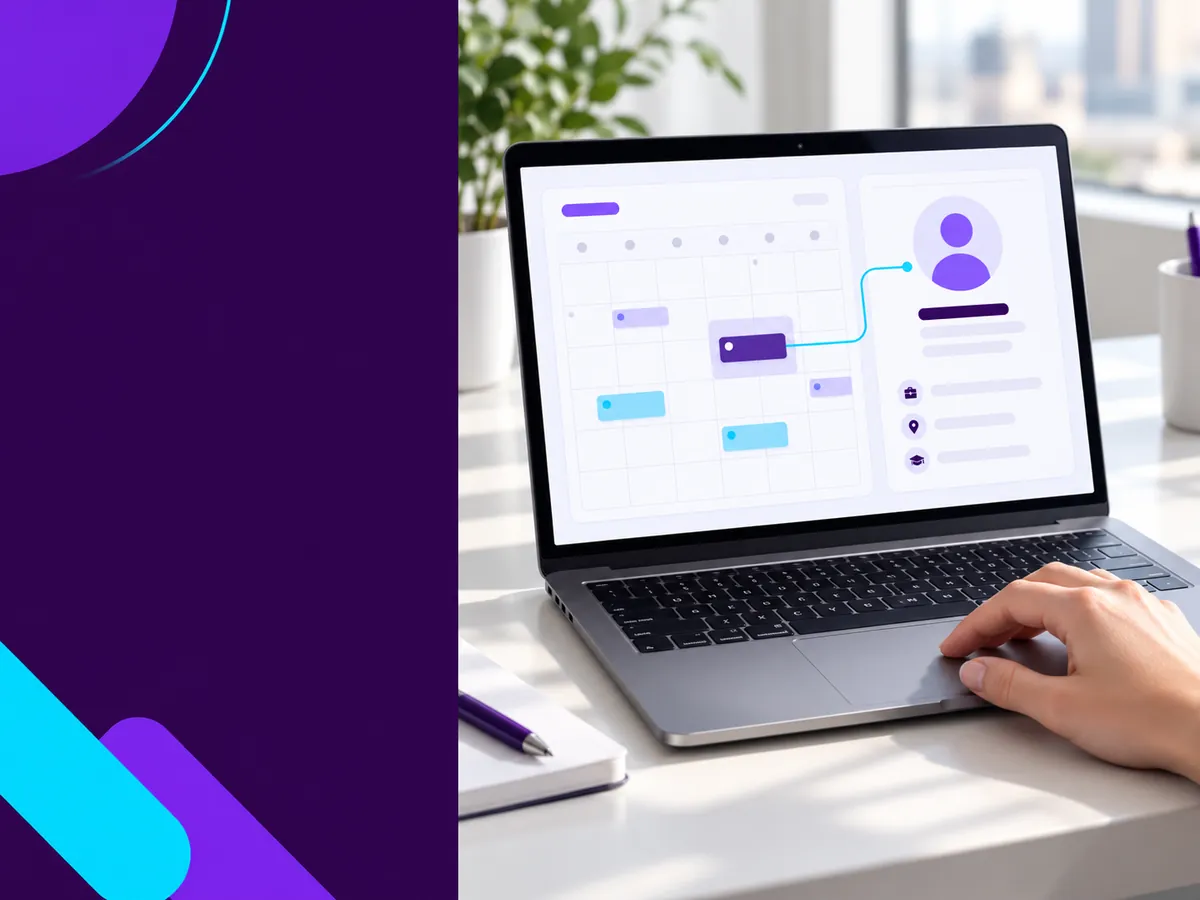
Staffing agency scheduling software is a tool that automates interview coordination among candidates, recruiters, and client hiring managers. It collects availability, sends invitations and reminders, handles reschedules, and logs each event against the candidate record. It matters because scheduling is the link between a matched candidate and a closed placement.
Two product approaches dominate the market, and the difference matters when you buy:
- Standalone schedulers. These tools sync with email and video conferencing and eliminate phone tag. Some integrate directly with an applicant tracking system (ATS), the database that records candidates as they move through hiring stages. Others require manual updates or a separate integration layer. Before buying, ask exactly how an interview outcome travels back into your pipeline.
- Scheduling inside a broader staffing agency software suite. Here, matching, pipeline stages, and scheduling read the same candidate record, so recruiters never re-enter data. Ask vendors to demonstrate that data flow live rather than accepting a slideware promise.
The distinction is practical, not technical. With a standalone tool that lacks a real integration, your team reconciles two systems at the end of every day. With an integrated approach, the calendar event and the candidate record stay in step by default.
How does interview scheduling automation actually work?
Interview scheduling automation handles the logistics layer of a placement: collecting availability, proposing times, sending confirmations and reminders, and recording outcomes. A well-configured system records booking and completion as separate events and updates pipeline stages only according to rules your team defines.
A typical automated flow looks like this:
- Availability collection. The candidate and the client each share their windows once, through a link or portal.
- Proposed slots. The system suggests overlapping times instead of the recruiter negotiating by email.
- Confirmation. Both parties receive calendar holds the moment a slot is accepted.
- Reminders. Automated messages go out at intervals you set, which reduces no-shows.
- Rescheduling. Either side can move the meeting without starting a new email chain.
- Outcome recording. Booked and completed interviews log as distinct events on the candidate record.
The important word is configured. A confirmed interview is not the same as a finished one, so a sound platform keeps those states separate. Pipeline stages then advance according to rules your team sets, not assumptions baked into the software.
What role does candidate matching AI play alongside scheduling?
Candidate matching AI produces the shortlist, and scheduling decides how fast that shortlist meets your client. Matching without fast scheduling wastes good sourcing, because slow logistics let rival agencies reach the same candidates first. The two functions work best when they share one candidate record.
Candidate matching AI scores profiles against a requirement using signals like skills, experience, and stated availability. That shortlist only creates revenue when interviews happen quickly. A talent matching platform that stops at the shortlist leaves the slowest step, logistics, untouched. For a closer look at the matching side, see how AI matching improves hiring velocity.
Ellevva's platform follows this sequence end to end: post a requirement, let AI score the best fit from verified profiles, track interviews, updates, and decisions in a single interview pipeline, and close the loop with transparent reporting.
"Make hiring faster, clearer, and more human." (Ellevva, company page)
Share on LinkedIn · Share on X

What does the fix look like in practice?
The comparison below is an illustrative workflow, not a promised outcome. Your results will depend on role volume, client responsiveness, and how well the rollout is managed.
A typical manual workflow:
- Availability gathered through a multi-day email chain for every interview.
- Reminders sent by hand, or forgotten entirely.
- Interview outcomes typed into the ATS at the end of the day.
- No visibility into which clients respond slowly.
The same workflow with automation:
- Candidate and client share availability through a single request.
- Confirmations and reminders go out automatically on rules you set.
- Booking and completion events log to the candidate record, with stage changes following your configuration.
- Reporting shows where interviews stall, so you can coach slow clients with evidence.
Treat faster coordination as a potential benefit, not a guarantee. Measure your time from submission to first interview before and after adoption, and judge any platform on your own numbers.
Which scheduling features should a growing agency demand?
Whether you buy a standalone tool or full recruitment agency management software, eight capabilities separate real automation from a shared calendar. Run this checklist before signing any contract for staffing agency scheduling software:
- Two-way calendar sync with Google Workspace and Microsoft 365.
- Self-serve booking links that respect availability rules for recruiters and clients.
- Automated reminders by email and SMS, with timing you control.
- One-click rescheduling that notifies every party at once.
- Separate booking and completion events, with stage updates driven by configurable rules.
- Interview activity on the candidate record, not trapped in a separate scheduling silo.
- Time-zone handling for remote and multi-region placements.
- Reporting on no-shows, submission-to-interview time, and recruiter coordination load.
At a glance
- Core problem: slow scheduling and manual follow-ups stretch time-to-fill and erode candidate interest.
- Fix to evaluate: scheduling that shares data with matching and pipeline tracking.
- Proof to demand: a live demo of booking, completion, and stage updates working together.
- Success measure: your own submission-to-interview time and no-show rate, before and after.
Modern ai staffing software often bundles these features with sourcing and analytics. When you audit your staffing agency tech stack, check whether scheduling data flows into the same reports you use for closures. If it does not, you will keep making decisions with half the picture.
What this means for you
Start by measuring one ordinary week of coordination. Count the hours each recruiter spends booking, reminding, and rescheduling, and note your average time from submission to first interview. Those two numbers are your baseline, and any vendor claim should be tested against them.
Next, mark which of those tasks are rule-based. Anything that follows a predictable pattern, such as a reminder sent the day before an interview, is a candidate for automation. Do not assume a proportion in advance; let your own log tell you how much of the week is logistics.
Then pilot with one desk or one cooperative client, and compare results against your baseline before rolling out further. For a measurement framework, see the recruitment operations metrics to track.
Ellevva is built as an ai hiring platform that combines AI matching, ATS workflows, and analytics in one workspace, with a pipeline that tracks interviews from requirement to closure. If you are evaluating platforms, explore Ellevva's solutions and test the workflow against the checklist above.
Frequently asked questions
What is the difference between scheduling software and an ATS?
An applicant tracking system is the database that records candidates and their stage in each hiring process. Scheduling software handles the calendar work of getting interviews booked, confirmed, and completed. Some platforms combine both, while standalone schedulers may integrate with your ATS or require manual updates.
How much time can interview scheduling automation save?
There is no reliable universal figure, because savings depend on interview volume, client responsiveness, and your current process. The practical approach is to log coordination hours and submission-to-interview time before adopting a tool, then compare after a pilot. Treat vendor time-saving claims as hypotheses to test against your own baseline.
Do small staffing agencies need scheduling software?
Small agencies often feel scheduling pain most, because every recruiter hour spent on logistics is an hour not spent sourcing. If your team handles more than a handful of interviews a week, automation is worth evaluating. Start with the checklist above and pilot with one cooperative client.
Will a scheduling tool work with the systems we already use?
It depends on the product. Some standalone schedulers integrate directly with popular ATS and calendar platforms, while others need a separate connector or manual updates. Ask every vendor to demonstrate the full data flow, from booked interview to updated pipeline stage, in a live demo.
Related resources
Tags: staffing agency scheduling software, staffing agency software, interview scheduling automation, candidate matching ai, ai hiring platform, talent matching platform, staffing agency management software, recruitment agency management software, ai staffing software, staffing agency tech stack