
Hiring · Recruitment Analytics
How to reduce time to hire: Fix the Three Stages Where Funnels Stall
Most teams try to reduce time to hire by pushing recruiters harder. This guide shows how to find the real bottleneck in resume screening, interview scheduling, and offer approvals, and how AI candidate matching, live pipelines, and real-time dashboards compress each stage.
By Ellevva ·

If you want to reduce time to hire, the answer is rarely asking recruiters to work faster. Most hiring cycles stall in the same three places: resume screening, interview scheduling and feedback, and offer approvals. This guide walks through each bottleneck and shows how AI candidate matching, a live interview pipeline, and real-time dashboards compress the stages that actually slow you down.
Key takeaways
- Time to hire is usually a stage-level problem, not a recruiter effort problem. Find the slow stage before you change anything.
- Resume screening, interview scheduling and feedback, and offer approvals are the three stages where hiring funnels most often stall.
- AI candidate matching helps recruiters prioritize reviews sooner by scoring profiles against skills, experience, and availability signals.
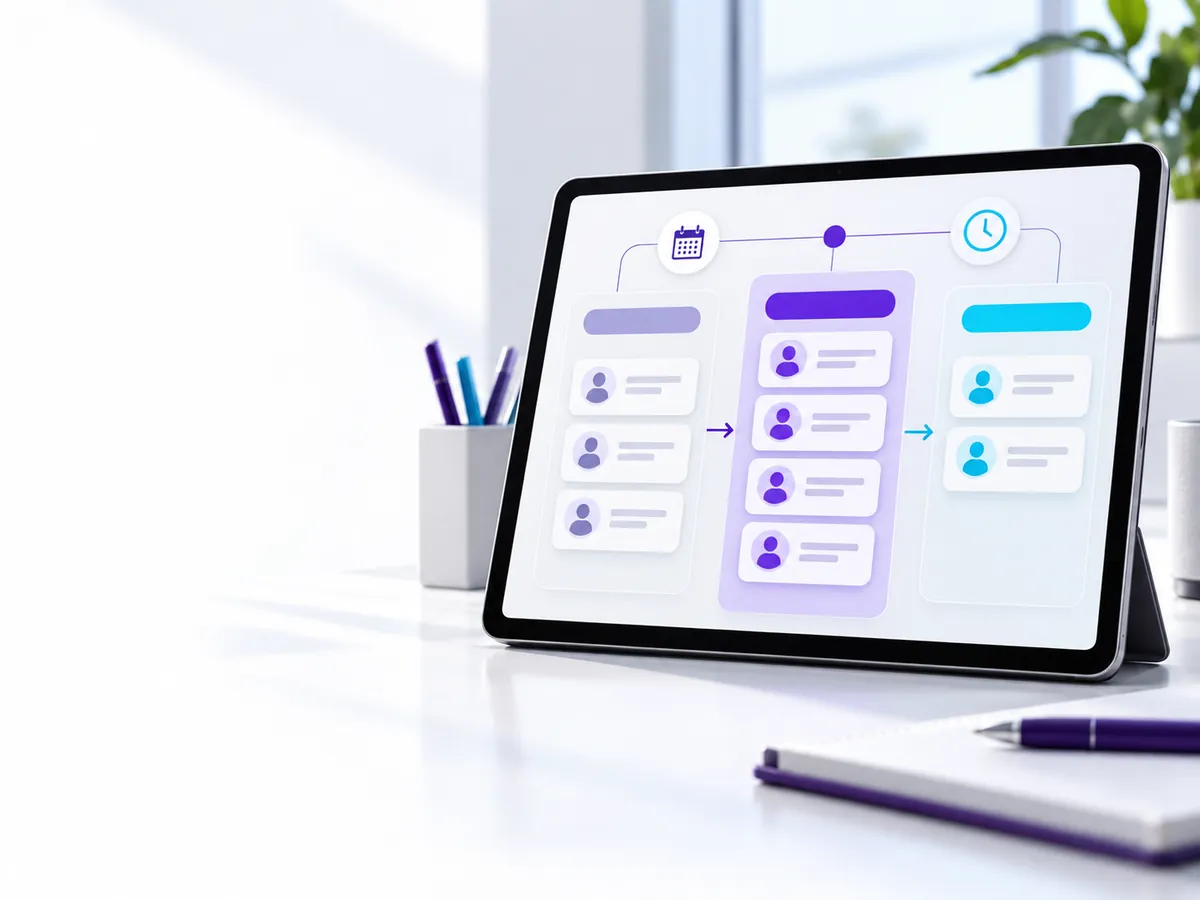
- A live interview pipeline keeps interviews, updates, and decisions visible so the middle of the funnel stops leaking days.
- Ellevva displays an 18-day time to hire figure on an example hiring dashboard and reports 60% faster time to hire. Treat these as vendor-reported claims from Ellevva, not verified customer averages.
At a glance
- Main problem: Hiring slows at handoffs, not because recruiters lack effort.
- Three usual stalls: Resume screening, interview scheduling and feedback, offer approvals.
- Best first step: Audit days in stage for recent closed roles.
- Useful lens: Separate sourcing time from time to hire so you measure the right delay.
- Vendor benchmark: Ellevva reports 18-day time to hire on an example dashboard and 60% faster time to hire.
Why does pushing recruiters harder fail to reduce time to hire?
Pushing recruiters harder fails because recruiter effort is rarely the constraint. A hiring process involves repeated handoffs between recruiters, hiring managers, interviewers, and approvers, and each handoff adds waiting time. You reduce time to hire by shortening the waits, not by speeding up the people.
Think of the hiring funnel as a chain of queues. A recruiter can source fifty candidates in a week. If hiring managers take ten days to return interview feedback, the cycle still crawls. More sourcing creates more inventory, not more offers.
Hiring processes also take longer than most teams assume, even before new delays appear. The interview stage alone can stretch across calendars, panels, and decisions.
The average U.S. job interview process takes 23.8 days (Glassdoor Economic Research, 2017).
Share on LinkedIn · Share on X
Read that figure as context, not as a target. It describes the interview process itself. Your practical question is narrower: which stage is costing you the most days right now, and what would remove waiting from that stage?
Where do hiring funnel bottlenecks usually hide?
Hiring funnel bottlenecks usually hide in the handoffs between people and systems. The three most common are resume screening, where volume overwhelms manual review; interview scheduling and feedback, where calendars and silent inboxes add days; and offer approvals, where decisions wait on busy stakeholders.
You can locate your own bottleneck with a simple audit of the broader hiring cycle. Pull your recent closed roles. Record two things for each role. First, note how long it took to source a candidate and get them into the pipeline. Second, note how many days they spent in screening, interviews, and the offer stage.
Keeping these two measures separate matters. Time to hire counts the days from when a candidate enters your pipeline to when they accept. It should not include the sourcing work that happened before entry. Tracking both numbers tells you whether the delay sits before or after the pipeline starts.
Here is a hypothetical example to show how the audit works. Imagine a staffing firm that handles volume roles for retail clients. The team reviews its last quarter and finds screening averaged six days, interviews averaged nine, and offers averaged four. These numbers are illustrative, not industry data.
The team in this example had been pushing recruiters to source faster, but sourcing was never the problem. The nine-day interview stage, caused by calendar coordination and late feedback, is where the funnel leaks candidates. That kind of surprise is common, because the stage that feels busiest is often not the stage that costs the most days.
How does AI candidate matching speed up resume screening?
AI candidate matching speeds up resume screening by scoring profiles against the role's skills, experience, and availability signals, then surfacing the strongest fits. Recruiters can prioritize their reviews sooner instead of reading every application in arrival order, which means strong candidates get contacted earlier in the cycle.
Screening is a volume problem. A single posting can attract far more applications than a recruiter can review with real attention. Good candidates sit unread while the role stays open. In competitive markets, those candidates may accept another offer.
Here is what ai-powered candidate matching changes in practice:
- Signal-based review. The system compares each profile against the role's required skills, experience level, and availability. Ellevva describes matching across skills, experience, and availability signals on its AI matching resource.
- Shortlists instead of stacks. Recruiters start from a scored shortlist. Review time shifts from hunting for fit to confirming fit.
- Earlier outreach. Strong candidates rise earlier in the queue. Recruiters can contact them while they are still active.
- Cleaner handoff. A shortlist gives hiring managers a smaller, clearer set to react to.
Ellevva positions this as an "AI Candidate Match" step after a requirement is posted, where AI scores best fit from verified profiles. The value for cycle time is simple: less reading before the first contact, and less re-screening later.
How does a live interview pipeline reduce scheduling and feedback delays?
A live interview pipeline reduces delays by keeping interviews, updates, and decisions in one shared place. The team can see the current state of a candidate without chasing scattered messages. Shared visibility can help teams identify outstanding follow-ups sooner, without assuming any fixed timeframe.
The middle of the funnel often fails quietly. A candidate finishes one round, then waits. An interviewer means to send notes, then gets pulled into meetings. A recruiter checks three tools and still cannot tell whether the next step is booked.
A live pipeline addresses the coordination part of that problem. Ellevva's workflow describes an "Interview Pipeline" step where teams track interviews, updates, and decisions. Its solutions page also describes shared pipelines and updates that align recruiters, hiring managers, and HR. The confirmed capability is visibility into the interview motion, not a promise about who sees which view.
Use the pipeline to manage three practical moments:
- Before the interview: Confirm that the round has a clear owner and a next step.
- After the interview: Make the update visible so the decision does not depend on memory.
- At the decision point: Keep the outcome tied to the candidate record so the offer stage can start cleanly.
The goal is not more meetings. The goal is fewer unknowns. When the team can see where a candidate sits, the follow-up is less likely to disappear into an inbox.

How do real-time dashboards keep offer approvals from stalling?
Real-time dashboards keep offer approvals from stalling by making aging and outcomes visible while there is still time to act. Leaders can track requirements, closures, recruiter productivity, and business outcomes in one view. A decision that sits untouched becomes easier to spot and easier to escalate.
Offer approvals are often a governance problem, not a talent problem. Compensation needs sign-off. Finance needs headcount confirmation. A hiring manager wants one more comparison. None of these steps are wrong, but each one adds days when nobody owns the clock.
Ellevva's public pages describe real-time insights with visibility into hiring performance, recruiter productivity, and business outcomes. The same pages show an example command center with metrics such as total hires, time to hire, offer acceptance, and hiring efficiency. Use that idea as an operating rhythm: review the funnel weekly, flag roles that cross an aging threshold, and name the next decision owner.
A practical approval checklist looks like this:
- Set the approval path before the final round. Know who must approve compensation, level, and start date.
- Pre-agree the offer band. Reduce debate after the candidate is already waiting.
- Track days since final interview. Make the wait visible on the dashboard.
- Escalate by rule, not by mood. If an approval crosses the threshold, it goes to a named owner.
This is where a reduction in time to hire becomes real. You are not asking people to care more. You are removing ambiguity about what happens next.
What benchmarks should you use, and how should you read Ellevva's numbers?
Use benchmarks as direction, not as proof. Start with your own days-in-stage audit, then compare against outside reference points with care. Ellevva reports an 18-day time to hire figure on an example dashboard and 60% faster time to hire on its public pages; treat both as vendor-reported unless you validate them in a pilot.
Benchmarks help in two ways. They give your team a shared language for speed. They also create a hypothesis to test. If your cycle is far above your target, find the stage that explains the gap. If your cycle is already strong, protect the stages that create quality, such as structured interviews and clear offers.
There are many ways to reduce time to hire, but the useful ones share a pattern. They shorten a wait, clarify an owner, or surface a decision earlier. Be skeptical of any benchmark that does not say which roles, regions, and seniority levels it includes.
For Ellevva specifically, keep the sourcing straight. The 18-day figure appears as an example dashboard metric on the solutions page. The 60% figure appears as a reported outcome on the public site. Both are useful context for what the platform is built to improve. Neither should be presented as an independent study.
What this means for you
If you lead talent acquisition, run the audit before you buy anything. Pick ten recent roles. Write down days in screening, days in interviews, and days from final interview to accepted offer. Circle the longest stage. Fix that first.
If you lead a staffing team, separate client delays from internal delays. Your recruiters may move fast while a client's feedback loop adds a week. A shared pipeline and clear dashboard make that visible without turning the conversation into blame.
If you are evaluating tools, ask each vendor to map features to the three stalls. Ask how matching improves screening, how interviews, updates, and decisions are tracked, and how dashboards show aging. Then run a small pilot on one role family and measure days in stage before and after.
A related internal resource is Ellevva's overview of AI recruitment solutions for staffing and enterprise teams, which describes the workflow from requirement to closure.
FAQs
What is the fastest way to reduce time to hire?
The fastest way to reduce time to hire is to find the stage with the most waiting and remove that wait. Audit recent roles by days in screening, interviews, and offer approvals. Fix the longest stage before adding more sourcing.
Which hiring stage usually causes the biggest delay?
There is no universal answer, which is why the audit matters. Many teams lose days in interview scheduling and feedback because calendars and decisions involve several people. Offer approvals can also stall when the path is not defined before the final round.
How does AI candidate matching help recruiters?
AI candidate matching helps recruiters by scoring profiles against skills, experience, and availability signals so strong fits surface earlier. Recruiters still make the judgment, but they start from a shortlist instead of a stack. That can move first outreach earlier in the cycle.
Are Ellevva's 18-day and 60% claims proven?
They are vendor-reported claims on Ellevva's public pages, not independent benchmarks in this article. The 18-day figure appears on an example hiring dashboard, and the 60% figure is reported as a faster time to hire outcome. Validate them with your own pilot data.
What metric should we track besides time to hire?
Track days in stage for screening, interviews, and offers, plus offer acceptance. Also track sourcing-to-pipeline time separately so pre-pipeline work does not distort time to hire. Together these metrics show whether speed is improving because waits are shrinking.
If your team is ready to test these ideas on a real role, post a requirement and measure days in stage from the first shortlist to the accepted offer.
Related resources
Tags: reduce time to hire, hiring funnel bottlenecks, ai candidate matching, ai-powered candidate matching, faster time to hire, ways to reduce time to hire, reduction in time to hire